基于 pi-tui 分支构建的第三方终端界面,为 DeepSeek Harness 提供键盘驱动交互。

- 语言
- TypeScript
- License
- MIT
- 分支
- main
安装
$ dsh plugin --profile web add @xmoon76/dsh-pi-tui在终端中运行以上命令,通过 dsh CLI 安装此插件。可在右上角切换 Profile。 第一次用 dsh?看这篇新手教程
对话式安装
帮我安装 DeepSeek Harness 插件 XMoon/dsh-pi-tui:先查看仓库 https://github.com/XMoon/dsh-pi-tui 确认安全性,然后执行安装命令并验证插件加载成功。
把这段指令粘贴给 DSH Web GUI 里的助手,由它代你完成安装与验证。
English | 简体中文
Release history: CHANGELOG.md · 简体中文更新日志
A third-party TUI mode for DeepSeek Harness (dsh), built on a vendored fork of pi-tui.
Run dsh --profile pi-tui for a terminal UI instead of the browser GUI (dsh --profile web) or one-shot mode (dsh --profile headless).
Status: working. The TUI covers the main session loop — input → session events, approvals, commands, session switching and full-text search — plus presets, skills, model/settings menus, and slash commands. Rendering and input routing are verified by headless tests (
@xterm/headless) with no TTY or model connection needed.
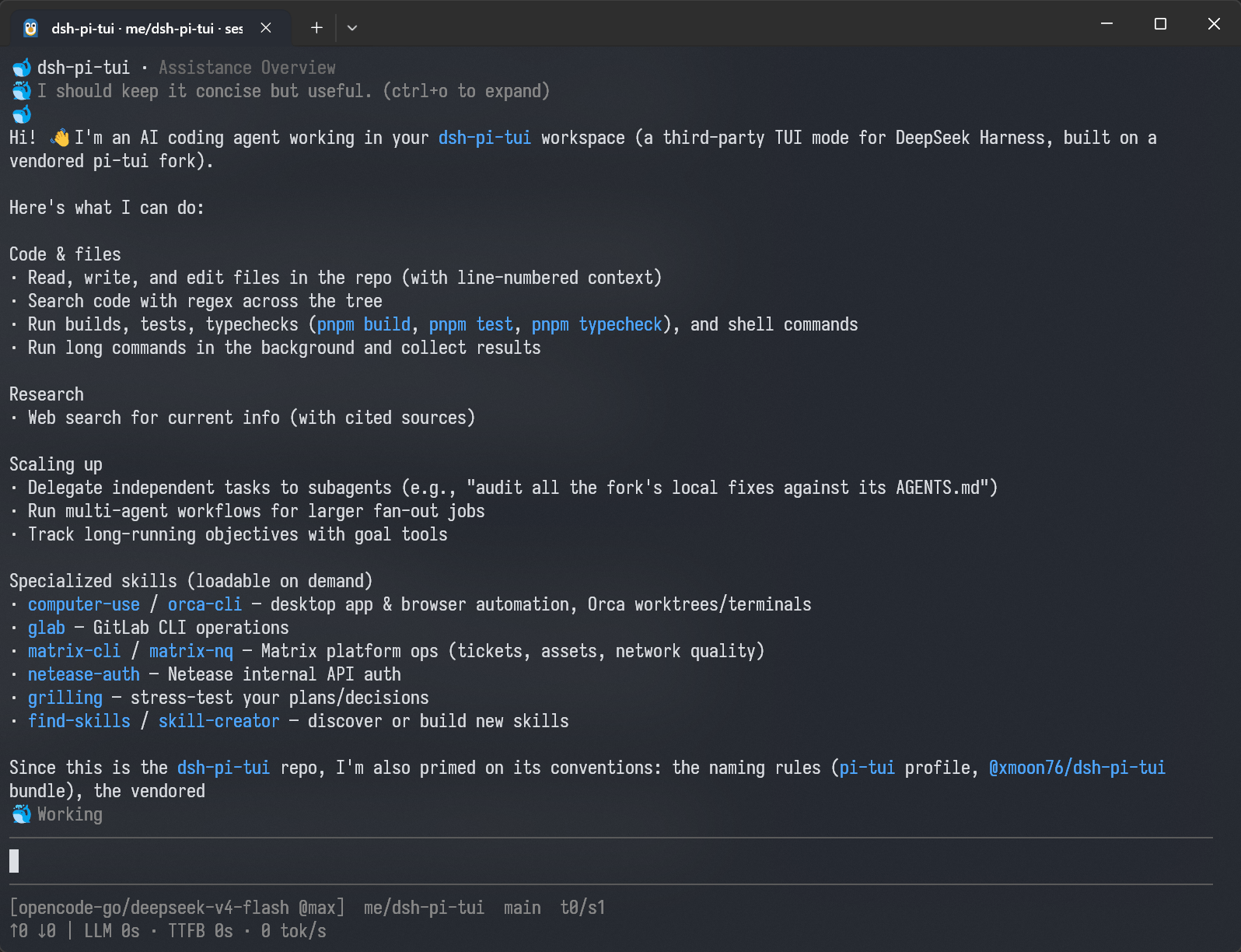
Screenshot
Layout
The full repository layout lives in AGENTS.md (the contributor
operating manual). In one line: the repository root is the published
@xmoon76/dsh-pi-tui bundle (the only published package — its manifest
declares dsh.bundle.patch and the exports point at the built dist/),
and packages/pi-tui/ is the vendored @moonshot-ai/pi-tui fork (rescoped
to @xmoon76/pi-tui, private, never published — its divergence ledger lives
in packages/pi-tui/AGENTS.md), bundled into the root package's build
output.
Prerequisites
- A DeepSeek Harness installation with profiles support (
dshon yourPATH). - Node >= 22.19 (
^22.19.0 || >=24, same range as dsh). Running from source needs Node with native TypeScript support (>= 23.6) or the tsx ESM hook (node --import tsx/esm, how dsh's own source launch works). - pnpm only when installing from source.
Install
dsh plugin runs pnpm inside the target profile's directory, so the usual
pnpm verbs (add, remove, update, list) all work.
Option A — from the npm registry (recommended)
The published package is self-contained: the vendored pi-tui fork is bundled
into its build output, so @xmoon76/dsh-pi-tui is the only package you install
(@xmoon76/pi-tui stays private in this repo, like kimi-code keeps
@moonshot-ai/pi-tui private):
# install the bundle into the pi-tui profile (creates the profile if needed)
dsh plugin --profile pi-tui -- add @xmoon76/dsh-pi-tui

# run it
dsh --profile pi-tui
Any dependency whose manifest declares dsh.bundle joins the profile's layer
stack automatically — no manual cordis.patch.yml wiring.
Option B — from source
Build artifacts are not committed (dist/ for both packages is gitignored and
the package exports point at the built files), so build before installing
from a clone:
git clone https://github.com/XMoon/dsh-pi-tui
cd dsh-pi-tui
pnpm install
pnpm build        # pi-tui tsdown (packages/pi-tui/dist/) + root tsdown (dist/, bundles pi-tui)

# file: — the bundle is copied into the profile at add time; rebuild + re-add
# to refresh (see "Update / uninstall" below)
dsh plugin --profile pi-tui -- add @xmoon76/dsh-pi-tui@file:$PWD

# link: — a live symlink instead; `pnpm build` output is picked up directly
dsh plugin --profile pi-tui -- add @xmoon76/dsh-pi-tui@link:$PWD
Verify the install
dsh plugin --profile pi-tui -- list          # @xmoon76/dsh-pi-tui present
dsh --profile pi-tui                         # TUI starts instead of the web GUI
Update / uninstall
# registry installs:
dsh plugin --profile pi-tui -- update @xmoon76/dsh-pi-tui
# file: source installs copy at add time — rebuild + re-add to refresh
# (link: installs track the repo live and need only `pnpm build`):
pnpm build && dsh plugin --profile pi-tui -- add @xmoon76/dsh-pi-tui@file:$PWD

dsh plugin --profile pi-tui -- remove @xmoon76/dsh-pi-tui
Development
pnpm install
pnpm build        # pi-tui tsdown (packages/pi-tui/dist/) + root tsdown (dist/, bundles pi-tui)
pnpm test         # pi-tui's own suite (node --test) + dsh-pi-tui headless tests
pnpm typecheck
node --expose-gc scripts/bench.mts   # performance baseline (optional)
Tests drive the UI through @xterm/headless (see test/virtual-terminal.ts),
so rendering and input routing are verified without a TTY or a model connection.
Development history (dogfooding)
This project started development on the browser surface (dsh --profile web) and
switched to building itself with itself: since August 15 2026, all fixes and
features are developed inside this TUI, the same way this README and the
codebase are maintained. The dev loop runs on a dedicated pi-tui-dev profile
installed with Option B's link: specifier
(dsh plugin --profile pi-tui-dev -- add @xmoon76/dsh-pi-tui@link:$PWD)
— a live symlink, so pnpm build is picked up without re-adding — while the
pi-tui profile stays on the published registry package for real use.
Extensions (early, stabilizing)
Since 0.2.0 the bundle ships a small, versioned extension surface so a
third-party Cordis plugin can contribute chrome without touching the TUI
internals. It is early and stabilizing: the capabilities below are the
current set; the API version (1) is bumped only on breaking changes, and
plugins must feature-detect capabilities instead of parsing the package
version.
All extension plugins remain standard DeepSeek Harness / Cordis plugins using
name, inject, and apply(ctx) against the single piTuiExtensions
service; the tiers are capability facades over that one service, not separate
plugin systems or runtimes.
The extension surface ships three tiers: a plugin imports ONLY the
public entry — never the stable entry's internals (TuiApp,
TuiMainScreen, TuiAltScreen) nor repository-relative paths.
| Tier | Entry | Contract |
|---|---|---|
| Stable | @xmoon76/dsh-pi-tui/extensions | compatibility-oriented; additive-first; existing semantics never silently change; removal requires a planned breaking change |
| Advanced | @xmoon76/dsh-pi-tui/extensions/advanced | experimental; minor releases may break; a migration note is required; no long-term shims |
| Unstable | @xmoon76/dsh-pi-tui/extensions/unstable | NO compatibility guarantee; implementation may change anytime |
All tiers reuse the SAME shared extension runtime: caller-fiber ownership, surface lifecycle, invalidation, capability discovery. Do not fork a second ownership/lifecycle model per tier. The tiers have grown since Phase 1:
- Advanced (
ADVANCED_API_LEVEL = 1, Phase 2 + Phase 4): normalized input capture, focused interactive surfaces (interactive managed overlays), advanced editor control, the imperative UI broker (select/confirm/input/notify), custom interactive UI and the host-state facade (theme/title/working/tools-expanded) — still Host-mediated, never raw terminal bytes. Author guide:docs/extension-advanced.md; Pi capability reference:docs/extension-capability-matrix.md. - Unstable (
UNSTABLE_API_LEVEL = 1, Phase 3): raw input interception (observe/consume/rewrite, exclusive raw ownership), the Host emergency fail-safe (triple-Esc), and a selected low-level surface seam — NO compatibility guarantee; a broken plugin can disrupt Host behavior. Author guide:docs/extension-unstable.md. - Real-plugin validation (Phase 5): the tier selection is proven by
real consumers in
examples/plugins/— a production-class vim modal editor (Advanced editor SDK), a questionnaire form (Advanced imperative UI broker) and an interactive shell (Unstable raw seam). The "which tier should I use?" decision tree:docs/plugin-authoring.md.
A plugin imports only the public entry:
import { PI_TUI_EXTENSIONS_SERVICE, type PiTuiExtensionService } from '@xmoon76/dsh-pi-tui/extensions'

export const name = 'my-plugin'
export const inject = ['tuiStartup', PI_TUI_EXTENSIONS_SERVICE]

export function apply(ctx: Context): void {
  const service = ctx.get(PI_TUI_EXTENSIONS_SERVICE) as PiTuiExtensionService
  if (!service.api().capabilities.has('slot.chrome.header.badge')) return
  service.register<{ text: string; tone?: 'info' | 'warning' | 'error' | 'success' }>(
    'chrome.header.badge',
    { id: 'my-badge', order: 100, description: 'A header badge from my plugin.' },
    { text: 'my-badge', tone: 'info' },
  )
}
Current extension points (v1):
| Slot | Semantics | Contribution |
|---|---|---|
chrome.header.badge | list | a short [badge] after the host title |
input.dock.item | list | a dock line above the todo panel |
chrome.footer.status | list | a footer segment (host owns width/truncation) |
input.widget.above / input.widget.below | list | a bounded widget around the editor (M4 component kit) |
Contributions are plain data, not render functions: a plugin supplies
HeaderBadge / DockItem / FooterSegment / InputWidget values (text +
semantic tone spans, or a structured ExtensionView tree for widgets) and
the host owns rendering, ANSI compilation, width budgets and truncation.
There is deliberately no render(context) callback in v1 — plugins never
hold a rendering context, so a contribution can never capture or mutate
host internals.
Since 0.2.0 the widget slots (input.widget.above / input.widget.below)
accept a bounded component kit: ExtensionView is a structured view tree
(text / markdown / spacer / stack / frame / rows views with
semantic style tokens) that the host compiles into private components. A
plugin can add helper rows above or below the editor — for example a status
widget or a quick-reference line — without touching the root layout, the
editor, or focus. The host owns the row budgets: under height pressure the
lowest-importance widgets collapse first, and the editor always survives.
service.register<InputWidget>('input.widget.below', {
  id: 'my-widget',
  order: 100,
}, {
  view: {
    kind: 'text',
    spans: [{ text: 'my-plugin ready', tone: 'success' }],
  },
})
Since M5 the extension surface also covers registries (plan §10):
registerCommand(contribution)— slash-command OWNERSHIP metadata (execution: 'local' | 'submission'): a plugin-declared local command always executes directly (never steered by the busy-Enter preference); a submission command flows through the session policy. Actual execution stays in the host's commands service;/name args...keepsrawInputverbatim. Name conflicts are reported, never guessed.registerTheme(contribution)— a named semantic palette selectable from the /settings theme picker; the owner's unload falls back to the built-in palette (a selected plugin theme never dangles).registerSetting(contribution)— a settings row appended to the /settings panel (label + current value + choices + optional rejection); the host owns the panel.registerAutocomplete(contribution)— an autocomplete provider consulted after the host's own provider returns null (deterministic order, per-provider isolation, latest-only commit).registerKeybinding(contribution)— normalized-key → semantic-action binding, routed by the host's InputRouter (M6). A plugin declares a key with the publicNormalizedKeyshape (key + ctrl/alt/shift/super) and a semantic action from the host's list (submit-draft,queue-draft,steer-draft,cancel-activity,open-search,toggle-fullscreen,cycle-permission). The host normalizes ALL terminal input (Kitty CSI-u, modifyOtherKeys, legacy sequences) — a plugin never sees raw escape data. Reserved host lifecycle keys (Ctrl+C/D/S/F/O/T/G/J, Ctrl+Enter, Enter, Esc) cannot be claimed; plain printable keys never fire a binding (typing always wins); bindings are non-capturing and fire LAST in the precedence ladder (after questions, approvals, overlays and the editor). The action executes through the host's own paths — submission/session safety is never bypassed.registerMessageRenderer(contribution)— a TRANSCRIPT message renderer (M7, chain slot): receives a semanticMessagePresentationSnapshot(immutable; never the mutable message or the container) and returns anExtensionVieworundefined(abdicate → the next renderer → the host fallback). Kind-scoped renderers apply to one message kind.registerToolRenderer(contribution)— a TOOL card renderer (M7, keyed slot): presents the card for ONE tool name from aToolPresentationSnapshot(callId, toolName, status, arguments, result, expanded); the winner (lowest priority) abdicates to the next renderer, then the host fallback. A priority tie on the same tool name is an explicit error. Renderers never stall the transcript: a throwing renderer is isolated and the chain continues, and the message cache embeds the renderer identity + registry revision, so an HMR/unload rebuilds exactly the affected components.showOverlay(view, options)— a MANAGED overlay lease (M8): the plugin supplies anExtensionView+ sizing hints; the host mounts it through its overlay broker (modal stacking, focus, fullscreen migration). The returned lease is generation-scoped (the surface's final dispose closes every still-owned lease), close() is idempotent, and hide()/show() toggle visibility without closing. A plugin can never mount a raw component or steal focus — the host owns the terminal and the overlay stack. The extension API v1 author guide records the import rules, the full surface table, the lifecycle/render contracts, the M11 deprecation policy and the stability contract.
The M10 acceptance fixture (plan §15): the repo ships a vim-mode fixture
(test/fixtures/vim-plugin/) that validates the editor-extension seam — the
packed public SDK is consumable by a third-party Cordis plugin, its
replacement editor receives SEMANTIC EditorInputEvents (never raw terminal
bytes), and editor create()/dispose() work — importing ONLY
@xmoon76/dsh-pi-tui/extensions. It is NOT a production Vim and NOT a
Stable-API completeness proof: modal-mode behavior (insert/normal) is not
part of the Stable contract, and the other public surfaces (commands,
themes, settings, autocomplete, keybindings, renderers, overlays, widgets)
have their own dedicated tests. Its CI gate forbids @xmoon76/pi-tui,
src/tui-app and repository-relative internal paths: if a STABLE plugin
ever needs a private import, the SDK is missing a capability (there is no
unsafeGetTuiApp() escape hatch).
registerEditor(contribution)— the EDITOR SDK (M9, plan §14): single-winner by priority (a tie is an explicit error); the winner occupies the editor seat through the host's ATOMIC handoff (create → transfer draft/cursor → mount → focus → dispose old). A creation throw keeps the current editor working; winner unload restores the next winner / the host default editor WITH the draft preserved. The plugin editor receives anEditorHost(surfaceId, generation, getSnapshot, replaceText, dispatch of semantic actions submit/queue-submit/steer/ open-external-editor, subscribe, invalidate) — but the host still owns busy-Enter, Ctrl+Enter, local-command classification, paste protection, approval/question capture, session guard/lock, external editor and exit: a plugin editor can never bypass those.
Lifecycle is host-owned: registrations are disposed when the plugin's Cordis
fiber unloads (HMR, disable), regular and fullscreen both refresh, and
handle.invalidate()/replace() re-render through the active screen. The
@xmoon76/dsh-pi-tui/builtins entry is the Loader-only first-party
contributor (version badge, turn/step counters, todo-summary dock item) —
not a stable third-party SDK. Raw terminal access, pre-host input
interception and full input ownership are NOT part of the Stable tier (see
the Advanced/Unstable roadmap).
Slash commands (selection)
/sessions [query]— open the session picker: search-as-you-type over session ids, titles, and workspaces, rows grouped by workspace with livefiltered/totalcounts, and titles loaded in the background as they are read. Enter switches to the selected session./search <query>— full-text search over persisted session logs, then switch to a hit./title [title]— with an argument, set the current session's title (pins it against automatic generation; titles appear in the/sessionspicker); without an argument, regenerate the title from the conversation — this overwrites the current title, including one you pinned earlier (/renameis an alias)./tasks— the merged task browser: background jobs AND subagents in one searchable list (type to filter rows by kind/label/status —subagent,bash,failed…).Enteropens the detail (child transcript for a subagent, status viewer for a job),iinterrupts the selected subagent./subagentsis an alias./yolo— switch todanger-full-access(alias of/permission danger-full-access)./status— show the current session's stats and identity (turn counts, token usage, workspace, installed dsh version)./preset,/model,/settings,/export,/fork— seedsh --profile pi-tui's command autocomplete (/+ Tab).
Keybindings (selection)
Ctrl+F— toggle transcript search (the/search <query>overlay; a second press closes it).Shift+Tab— cycle the permission preset (read-only → workspace-write → danger-full-access); the footer's mode slot badges every preset ([workspace-write]/[read-only]/[custom], with[yolo]flagging the no-approval mode).Ctrl+S— steer: with queued messages, sends the whole queue (plus the draft, if any) into the running turn at once; otherwise sends the draft alone. An idle agent starts a fresh turn with everything.Alt+↑— dequeue: pull every queued message back into the editor draft.Ctrl+T— toggle the full todo list (in fullscreen, clicking the panel expands it to the full list and back); the dock above the editor always shows the todo summary and background tasks, and queued input renders between them.@— file/folder mentions in the editor:@+ Tab completes files from the whole workspace (fd-backed whenfdis on PATH, with a built-in recursive fallback otherwise). The literal@pathis submitted and the model reads the file itself. With background work running, an empty editor's↓opens the same merged task browser as/tasks:- subagent rows (live continuable children) —
Enteropens the child's transcript read-only (Escreturns);iinterrupts the selected child. They never register jobs records, so this browser is their only glanceable home. - job rows (bash and one-shot subagent jobs) —
Entershows the status viewer only: a bash job's output read cursor belongs to the model'sjob_output, and a one-shot subagent job record carries no child session id, so a subagent job's transcript is reached through/tasksby picking the child by its label. The footer badge shows[N tasks running · M agents · ↓ view]while any background work is live. The queue pane above the editor shows pending input: user messages as❯rows, everything else (job notices, subagent reports, injected instructions) as⏳notices that fold into a+N moreline beyond five — and disappear once the agent has received them.
- subagent rows (live continuable children) —
Launch options
The TUI's startup row adds --preset <id> — the agent preset a fresh
session starts on (falls back to $DSH_PI_TUI_PRESET, then the saved
settings default). It exists because /preset only applies to a blank (not
yet created) session, so launch-time selection is the other half of choosing
a preset. All other flags are the dsh runner's own (--session <id>, …).
Session lifecycle
Opening the TUI with no --session creates no session at all: the first
user message (text, slash command, Ctrl+S steer, or ! shell) starts it
lazily. --session <id> still resumes immediately, and a local !! command
runs without needing a session.
Verified in the P0 spike
- Vendored pi-tui: the fork's own suite passes under
node --test(run it as the sync gate after every re-vendor; the count is deliberately not copied here —packages/pi-tui/package.jsonis the single source of version facts). TuiApprenders, accepts editor input, and handles Ctrl+C on a headless xterm.- The whole import chain (pi-tui, tui-app,
@deepseek-ai/dsh-cmdline, commander) loads under the tsx ESM hook — the dsh source-launch contract. - Native modifier-key addons are optional: on Linux the loader returns
undefinedwithout attempting a load, and the non-TTY stdin path is guarded.
Diagnostic log
The TUI writes its own diagnostics to stderr and a log file (ctx.logger is
invisible in this process — no exporter):
- Default file:
$DSH_HOME/logs/pi-tui-<pid>.log(default~/.dsh/logs/); - Line format:
[tui] <ISO time> <level> <message> k=v ...; - Default level
info: key lifecycle events only (boot/resume/switch/exit, divergence-guard warnings, errors);debugadditionally logs every guard check before a send.
Configuration (environment variables):
| Variable | Meaning | Default |
|---|---|---|
DSH_PI_TUI_LOG | Log file path; off disables file logging | $DSH_HOME/logs/pi-tui-<pid>.log |
DSH_PI_TUI_LOG_LEVEL | debug / info / warn / error | info |
Troubleshooting example:
DSH_PI_TUI_LOG_LEVEL=debug dsh --profile pi-tui
tail -f ~/.dsh/logs/pi-tui-*.log
Safety & operational notes
- One surface per session. dsh has no cross-process session coordination:
a session open in TWO dsh processes (TUI + web, or two TUIs) can corrupt its
log. The TUI refuses to open a session already held by another live dsh
process (an
owner.lockfile next to the log, with a pid/starttime probe for stale locks left by crashes — so the second surface is stopped at OPEN time, not after the damage). For writes, the TUI detects the other writer and blocks the send; the SAME action pressed again (Enter for a submit, Ctrl+S for a steer, unchanged draft) forces through — an edited draft, a swapped key, a new file revision, or a session switch invalidates the force. Never run two surfaces on one session (full contract:docs/concurrency.md). - Session repair.
node_modules/@xmoon76/dsh-pi-tui/scripts/repair-session.mjsrepairs corrupted logs (--scanlists damage read-only;--yesapplies with a mandatory backup). A torn (truncated) tail is truncated at the last complete frame and reported with exact byte accounting; references to a duplicated seq are never auto-resolved — the repair refuses and asks for--duplicate-reference=first|last|segment. Repaired logs are re-verified with the dsh reader's own layout checks before the backup is considered redundant. (Full repair contract, incl. the frame-layout constraint:docs/repair-session.md.) - Exit.
/exit(alias/quit) flushes the session with a 10s hard timeout: a hung provider cannot trap the TUI. If the flush fails or times out, the terminal prints a warning (the tail may not be persisted) and the process still exits. - Performance.
scripts/bench.mts(non-default) measures ingest, projection, cold/warm rebuilds, streaming frames, theme switches, and heap; the saved baseline lives indocs/perf-baseline.md. Unchanged transcript messages reuse their rendered components, so the warm per-frame rebuild does not grow with history.
License
MIT. packages/pi-tui retains its upstream MIT license and authorship
(Copyright (c) 2025 Mario Zechner; Moonshot AI fork).
查看使用指南 →
该插件的安装步骤、关键要点、FAQ 与兼容性说明(基于已收录字段派生)。
收录徽章

[](https://deepseek-plugin.org/plugins/XMoon/dsh-pi-tui)把这段 markdown 粘贴到你的 GitHub README,链接回本插件详情页。徽章只声明已被本站收录,不代表安全认证。