flowix/app/flowix-dsh-host/vendor/deepseek-harness/packages/bundle/web-app
DSH 浏览器表层组合包:在 dsh-base 之上叠加 Web profile,承载 dsh --profile web 命令行解析、Web 服务粘合、前端 dist 服务、提示词段落与 bash 运行时变量。

- 语言
- TypeScript
- License
- MIT
- 分支
- main
安装
$ dsh plugin --profile web add github:text2future/flowix/app/flowix-dsh-host/vendor/deepseek-harness/packages/bundle/web-app在终端中运行以上命令,通过 dsh CLI 安装此插件。可在右上角切换 Profile。 第一次用 dsh?看这篇新手教程
一句话定位
DSH 浏览器表层组合包 @deepseek-ai/dsh-web-app,在 dsh-base 之上叠加 dsh --profile web 这一表层所需的全部宿主行(webserver、API 网关、workspace、投影缓存、存储、浏览器插件名录、客户端插件 HMR 链)和 web-runtime 粘合插件,承载命令行解析、前端 dist 服务、Web 表层提示词、bash 运行时变量和就绪 URL 行的打印。
核心能力
- 解析
dsh --profile web命令行:支持--host、--port、可重复的--trusted-host、--help,并将--host 0.0.0.0与非数字--port视为用法错误 - 在 dsh-base 之上插入 Web 特有的宿主行:webserver、API gateway、cordis host/client runner、code-runtime、storage / storage-json / storage-domain、workspace、session-projection-cache、session-stats、message-feedback、session-log-export、directory-picker、plugin-inventory、agent-presets 等
- 注入客户端插件名册(
dsh.client行):client-connection、api-remotes、client-runtime、ui-theme、ui-layout、ui-sidebar、ui-conversation、ui-tool、ui-cordis、ui-deliverables、ui-workspace、ui-input-trigger、ui-commands、ui-skill、ui-subagent、ui-jobs、ui-goal、ui-message-feedback、ui-model-selection、ui-permission、ui-agent-preset、ui-settings*、ui-plan、ui-user-questions、ui-trajectory 等 - 把 coding persona 设为
You are a coding agent powered by the {{model}} model. Your working directory is {{cwd}}.,禁用一系列面向 TUI 的工具/技能/计划/工作流行(tool-bash、tool-pwsh、tool-jobs、tool-fs、tool-fs-search、tool-str-replace-editor、skill-filesystem、tool-skill、tool-goal、plan-mode、compaction-basic、command-compact、tool-result-pruner、tool-subagent*、workflow-worker-thread、tool-workflow、tool-ralph、agent-instructions、tool-todo、tool-web、hmr) - 通过
web-runtime粘合插件:解析@deepseek-ai/dsh-web-frontend/dist/index.html,挂载frontend-static回退席位所有者;只在启动时采样一次依赖 bind 的 LAN 信任信息并以webRuntime服务提供给浏览器信任栅栏;在surfaceContext=true时注册harness:source和app:web-surface(order −98)提示词段落,以及 bash 运行时变量DSH_WEB_URL;在printUrl=true时等本表层 Loader 配置树结算后打印dsh web:URL 行
技术实现
- 语言: TypeScript(strict ESM)+ YAML(cordis.patch.yml 静态清单)
- 关键依赖:
@deepseek-ai/cordis(peer,函数插件协议载体)+commander(命令行解析)+@deepseek-ai/schemastery(Config schema)+ 40 余个@deepseek-ai/dsh-*工作区包作为传递依赖 - 架构模式: 函数插件组合包——
cordis.patch.yml通过package.json#dsh.bundle.patch被 profile 组合器静态加载,运行时由src/index.ts(web-runtime)+src/startup.ts(web-startup)+src/invariant.ts(空操作 invariant 安装器)三部分承担;web-startup先解析命令行并把webStartup作为普通 Cordis 服务发布,flag 配置的行(webserver、web-runtime)再inject: [webStartup],因此参数解析完成前不会绑定端口 - 入口文件:
cordis.patch.yml(profile 加载时使用)+src/index.ts(web-runtime 粘合插件)+src/startup.ts(web-startup 命令行提供方)
适用场景
想用浏览器 GUI 跑 DSH agent 而非终端 TUI 时,需要这个组合包作为 dsh --profile web 表层:它在 dsh-base 之外补齐浏览器渲染需要的所有宿主行与客户端 UI 插件,并替代理配置 web-server、命令行、前端 dist 服务、面向模型的 Web 表层提示与 bash 运行时变量。普通终端用户无需直接接触,profile 维护者把它作为第二层 patch 叠加在 dsh-base 之上即可。
前置依赖与兼容性
| 依赖 | 最低版本 | 说明 |
|---|---|---|
| DSH | >=0.1.0-rc.5 | 本包自身 version;必须叠在 dsh-base(>=0.1.0-rc.5)之后 |
| Node.js | >=22.19 | 工作区 engines.node 要求 ^22.19.0 || >=24.0.0,本包未单独声明 |
| 平台 | macOS / Windows / Linux | 通过 LAN 信任栅栏(trustedHosts)约束外部主机;不绑 0.0.0.0 |
| 原生模块 | 无 | 纯 JS/TS + YAML;运行时依赖 node:os.networkInterfaces() 取本机 IPv4,无 node-gyp |
安装方式
dsh plugin --profile web add github:text2future/flowix/app/flowix-dsh-host/vendor/deepseek-harness/packages/bundle/web-app
配置项
| 配置 | 类型 | 说明 | 默认值 |
|---|---|---|---|
printUrl | 布尔 | 启动成功后是否在终端打印 dsh web: URL 行;非交互层可关掉 | true |
surfaceContext | 布尔 | 是否给模型注册 harness:source 与 app:web-surface 提示词段落,以及把 DSH_WEB_URL 注入 bash 环境;一次性非交互层在用户不在 GUI 时可关掉 | true |
trustedHosts | 字符串数组 | 本次调用通过 --trusted-host 显式传入的额外可信主机(host 或 host:port,可重复),与启动期采样的 LAN IP 字面量共同构成 webRuntime.trustedHosts | [] |
CLI --host <host> | 字符串 | webserver 绑定的主机;0.0.0.0 会被 CLI 显式拒绝 | 未设置时回落到 patch 中的部署默认值 127.0.0.1 |
CLI --port <port> | 数字 | webserver 监听的端口;传 0 让 OS 选空闲端口 | 未设置时回落到 patch 中的部署默认值 3080 |
CLI --trusted-host <authority...> | 字符串(可重复) | 浏览器信任栅栏额外接受的可信主机(host 或 host:port) | 无 |
CLI -h, --help | 开关 | 打印本应用的帮助;不会启动服务也不会发布 webStartup 服务 | — |
常见问题
Q: web-runtime 和 web-startup 有什么区别?
A: web-startup 是普通的命令行提供方(src/startup.ts),注入 cmdlineArgs 后用 commander 解析 --host、--port、可重复的 --trusted-host、--help,把结果以 webStartup 服务发布;web-runtime(src/index.ts)才是叠在 base 之上的粘合插件,它注入 webStartup、在拿到 webServer 之后才发布 webRuntime、挂前端 dist 服务、注册提示词段落与 bash 变量,并在就绪后打 URL 行——前者负责命令行,后者负责运行时粘合。
Q: 启动后看到了 dsh web: http://127.0.0.1:xxxx (LAN: http://192.168.x.x:xxxx) 这一行说明什么?
A: 这一行是就绪信号:本表层所有宿主行已成功挂载、Loader 配置树已结算、webServer 仍存在;监督进程看到这行就会立刻开始 RPC。如果用了 0.0.0.0 绑定、并且 --trusted-host 也为空,括号里的 LAN URL 会从启动期 networkInterfaces() 的 IPv4 快照里取第一条。
Q: 我想在自己部署里关掉 URL 行或者关掉面向模型的 Web 表层提示,怎么办?
A: 在自己 profile 的更高层 patch 里覆盖 web-runtime 行的 printUrl(设为 false 就不打 URL 行)或 surfaceContext(设为 false 就不注册 harness:source/app:web-surface 提示词段落,也不注入 DSH_WEB_URL bash 变量)。trustedHosts 也可在那里扩展为例如 ['app.internal', ...ctx.webRuntime.trustedHosts]。
Q: 启动时报 web-app: frontend dist not built; run pnpm run build from the repository root first 怎么办?
A: 这是设计内的失败:web-runtime 通过 require.resolve('@deepseek-ai/dsh-web-frontend/dist/index.html') 解析前端 dist,没源码降级路径。在仓库根执行 pnpm run build(或 pnpm run build:web 单独构建前端)后再启动即可。
Q: 我能在浏览器里通过 LAN 主机访问本机 GUI 吗?
A: 默认不能:webserver 绑的是 127.0.0.1,而 --host 0.0.0.0 被 CLI 拒绝。最稳的做法是把 --host 设为本机 LAN IPv4,并通过 --trusted-host 把目标 host(含端口)显式列入信任栅栏;若确实要绑所有接口,请改用其他方式并自行承担暴露远程代码执行的风险。
Q: 客户端插件改了之后浏览器能自动刷新吗?
A: 客户端插件重载链路(dsh-client-hmr)在 Web profile 下已挂载但当前整体 HMR 处于关闭状态(cordis.patch.yml 中 hmr 行 disabled: true,README 标记 TODO:待重载生命周期测试通过后再启用)。在该 TODO 解决前,客户端插件改动不会无刷新自动刷新;GUI shell 与普通 package 改动则需要重建 Web 产物并手动刷新页面。
上手难度
进阶 — 需要理解 DSH 的 cordis.patch.yml 分层叠加规则、web-startup 与 web-runtime 两个服务的依赖顺序,以及 Commander flag → 服务 → 表达式解析的链路;普通用户一般通过 dsh --profile web 直接使用,profile 维护者才需要编辑这一层。
已知问题与限制
- 前端 dist 必须已构建:
web-runtime通过require.resolve('@deepseek-ai/dsh-web-frontend/dist/index.html')解析,激活时找不到会直接抛web-app: frontend dist not built; run pnpm run build from the repository root first,没有从源码服务前端的降级路径 lanAddresses是启动期快照:web-runtime 只在apply时采样一次networkInterfaces();启动后网卡增删或 IPv4 变化不会被重新公告,已打印的 LAN URL 始终等于本次启动期构建的信任栅栏- 共享 HMR 当前关闭:
cordis.patch.yml第 22–23 行将hmr行设为disabled: true,并注释TODO: Re-enable shared HMR for Web after its reload lifecycle is tested.;客户端插件重载链路 (dsh-client-hmr) 仅在显式启用该行后才真正生效 - CLI 不支持
--host 0.0.0.0:出于安全考虑,src/startup.ts:69-71主动拒绝全接口绑定,给出明确错误提示

Notes for you,
Memory for your agents.
The Markdown notebook where your words seamlessly become durable context for AI agents.
Markdown · Open Source · Multi Agent · MCP & CLI
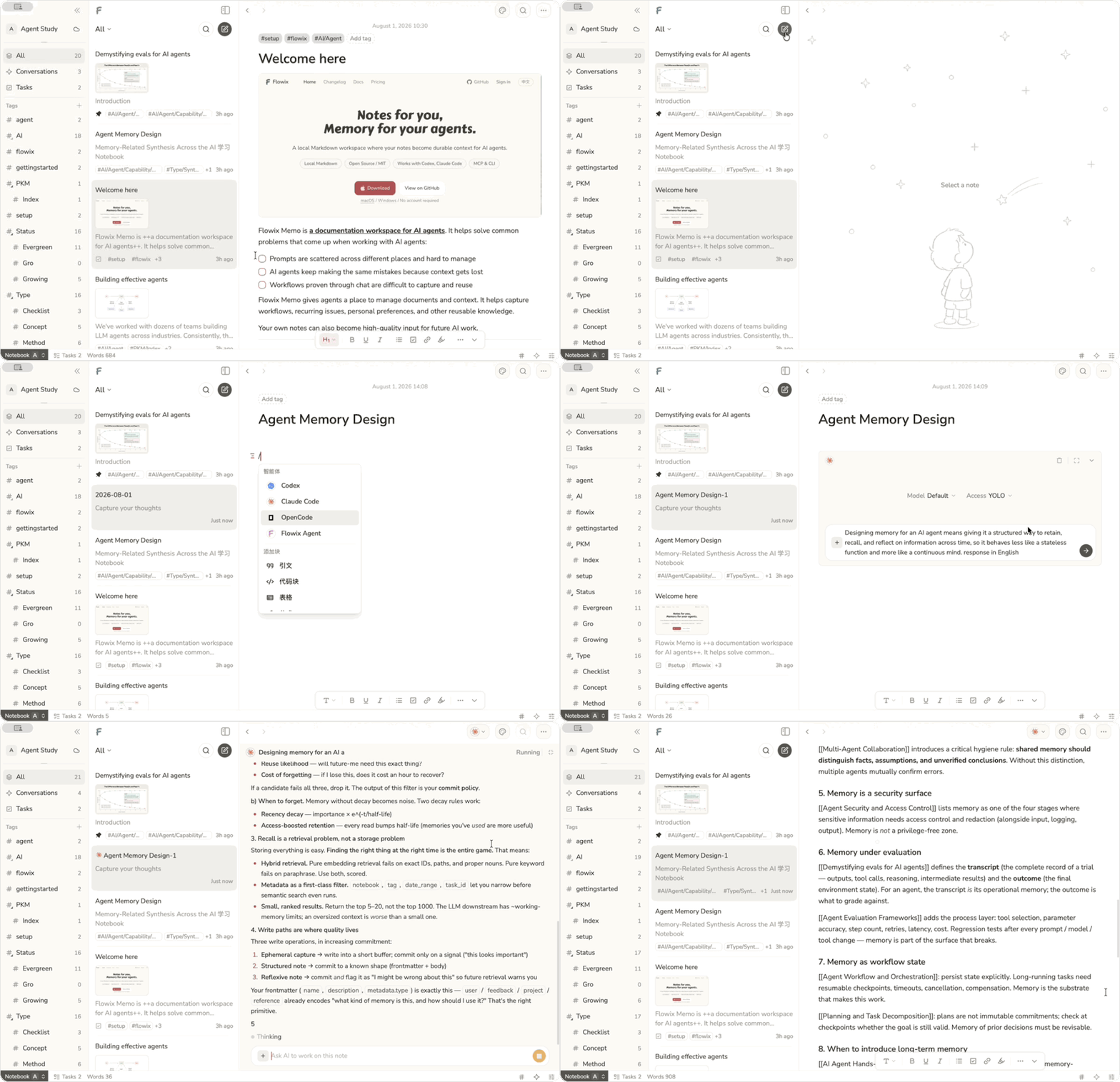
Flowix turns notes into working memory
Write in Markdown, point an agent to the context it needs, and save the result back to the same note — ready to review, edit, and reuse next time.
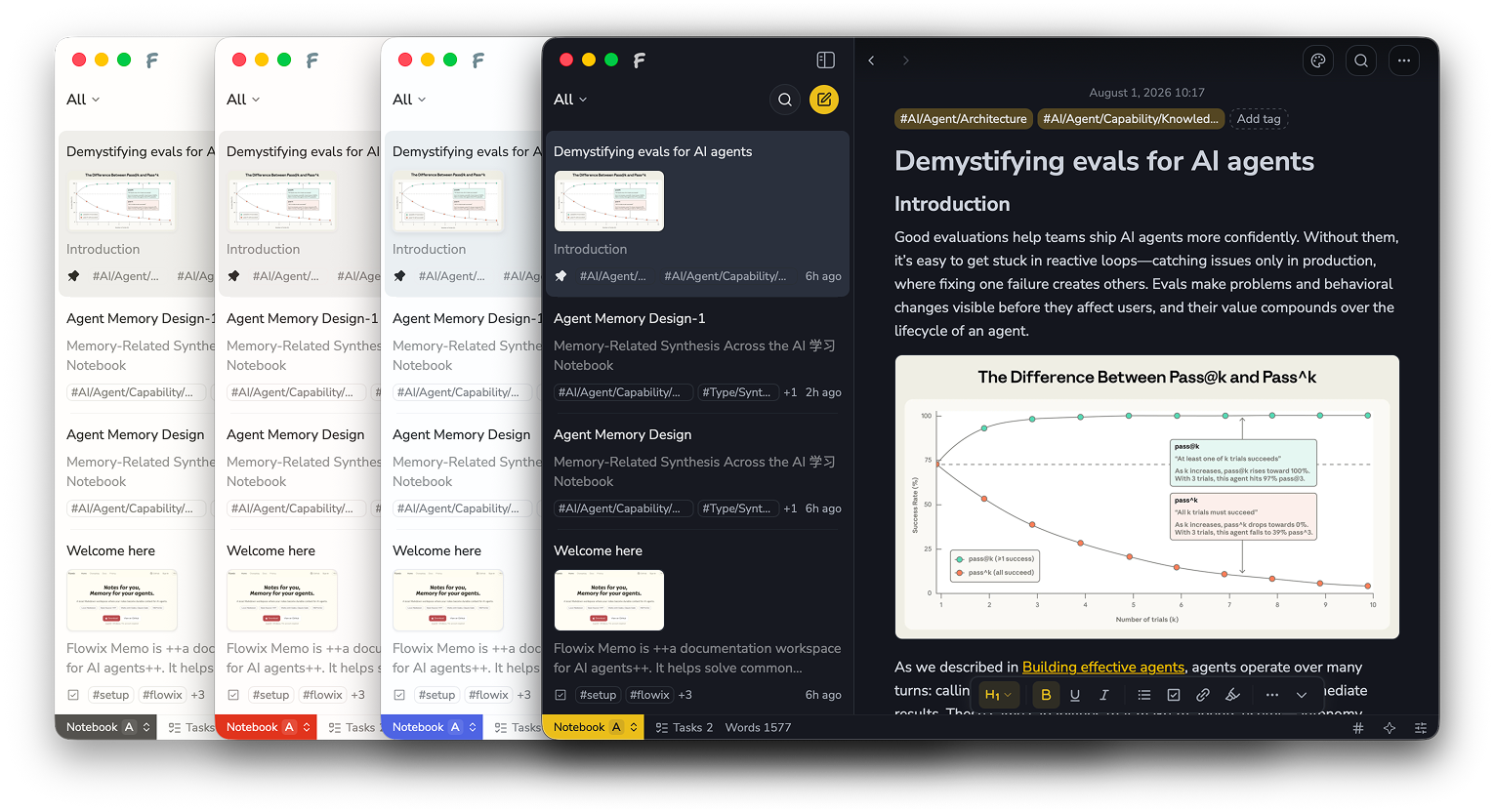
Keep work moving
Keep product work, development, research, and personal knowledge together, so agents can continue without starting over.
| Use case | What it does |
|---|---|
| Product work | Keep requirements, feedback, decisions, and PRDs up to date. |
| Software development | Give coding agents the context to continue your project. |
| Research | Keep sources, analysis, and conclusions together and reusable. |
| Personal knowledge | Turn notes, plans, and preferences into useful agent context. |
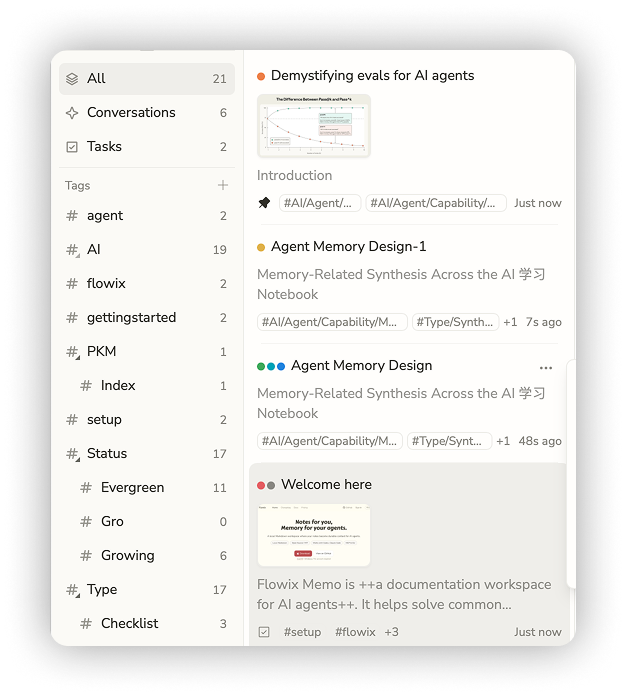
Connect every agent to the same memory
Use agents inside Flowix or connect Codex, Claude Code, OpenCode, Hermes, and other MCP or CLI tools — all working from the same notes and context.
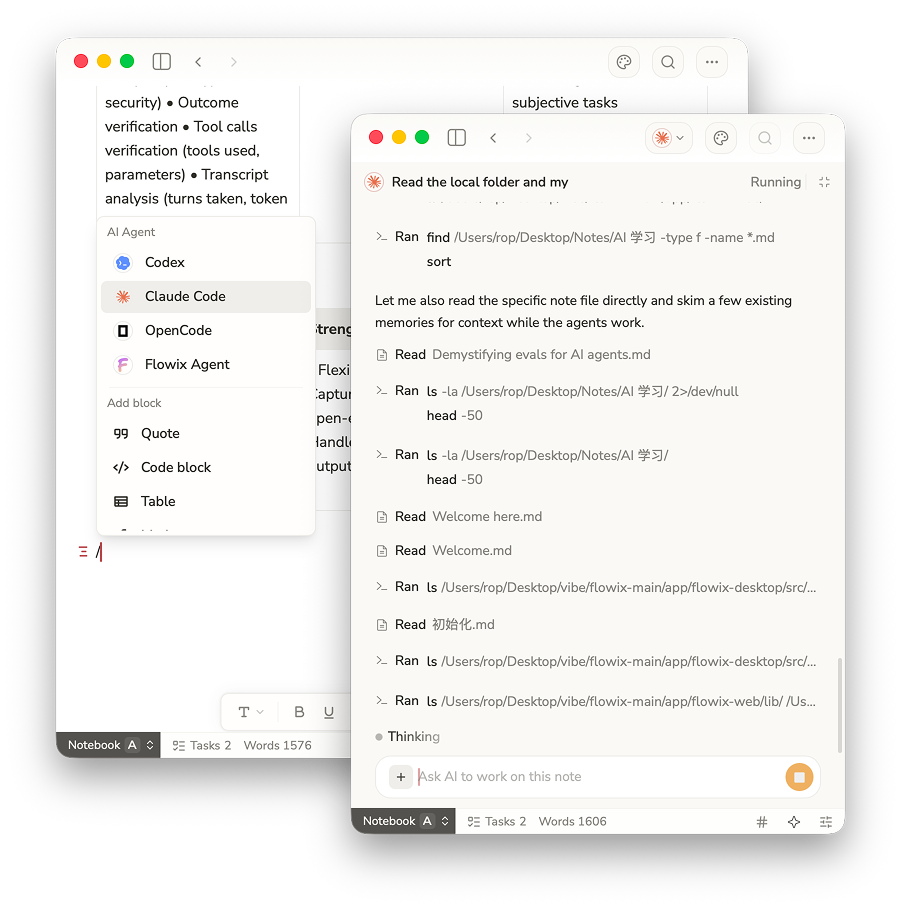
dsh-flowix-memory plugin
dsh-flowix-memory is a DeepSeek Harness plugin that connects any Harness agent to your local Flowix notes through the bundled flowix-cli MCP server: the agent gets the mcp__dsh-flowix-memory__flowix_memo tool to search, read, create, and edit Flowix memos (including mind maps).
Install it into a Harness profile (--profile <name> is required; shipped profiles: web, headless), from the flowix-main checkout (not yet published to npm):
dsh plugin --profile <name> add ./app/flowix-dsh-host/bundles/dsh-flowix-memory
Requires the flowix CLI on PATH (or set FLOWIX_CLI_PATH) with access to your notebook data (~/.flowix). See the plugin README for details.
Your notes stay local and under your control
Flowix keeps your work as plain Markdown files on your device. You choose what agents can access, when context is sent, and how your files are synced, backed up, or versioned.
- Files you can open anywhere — Your notes are saved as plain Markdown on your device, so you can read and edit them with other apps.
- Agents see only what you choose — Share a single note, a folder, or a whole notebook — only when you want an agent to use it.
- Use the agents you already trust — Connect Codex, Claude Code, OpenCode, or another external agent. Flowix shares only the context you choose, when you start a task.
- Sync and back up your way — Use the sync, backup, or version-control tools you already trust. There's nothing to export.
Product preview
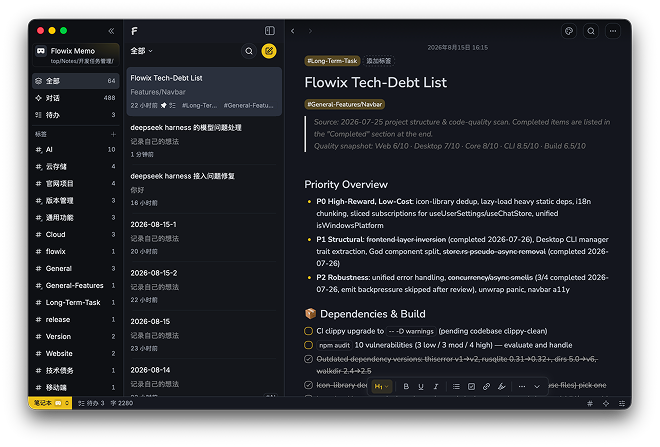 Note library with tags | 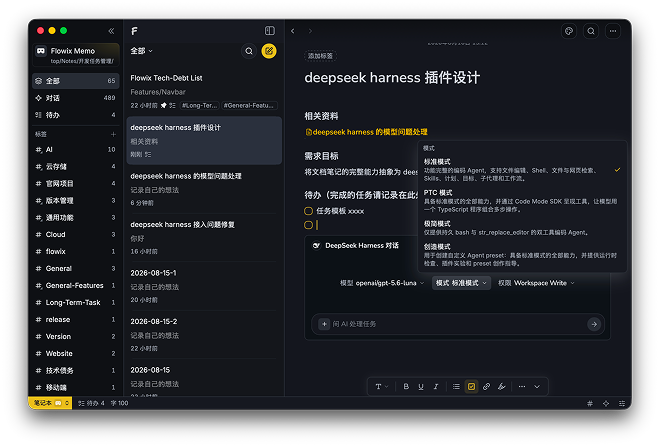 Note detail with agent presets |
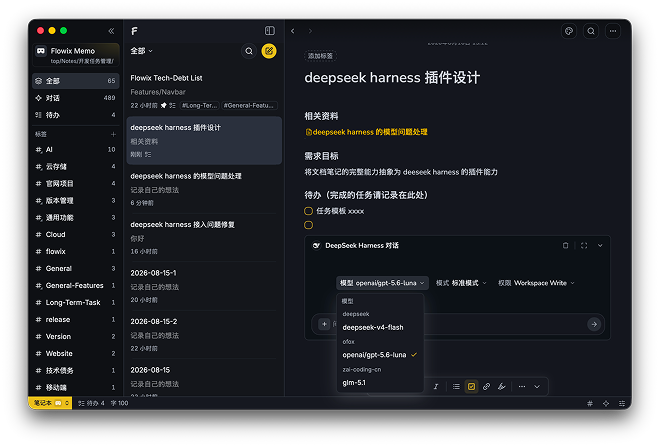 Agent model picker | 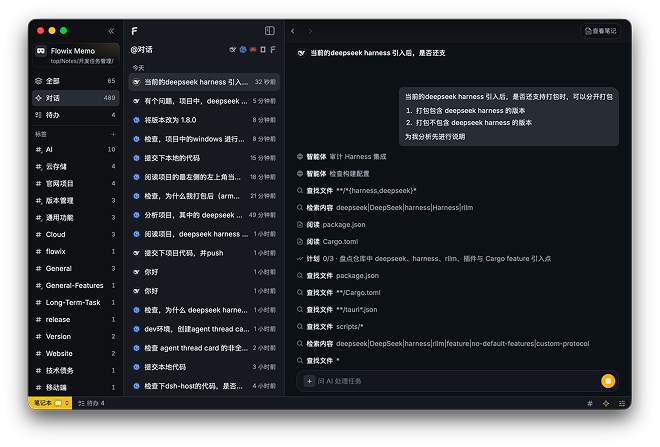 Full-text and file search |
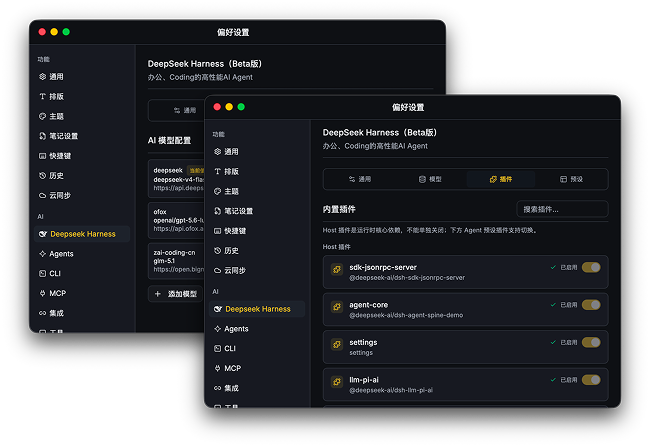 Provider and MCP configuration | 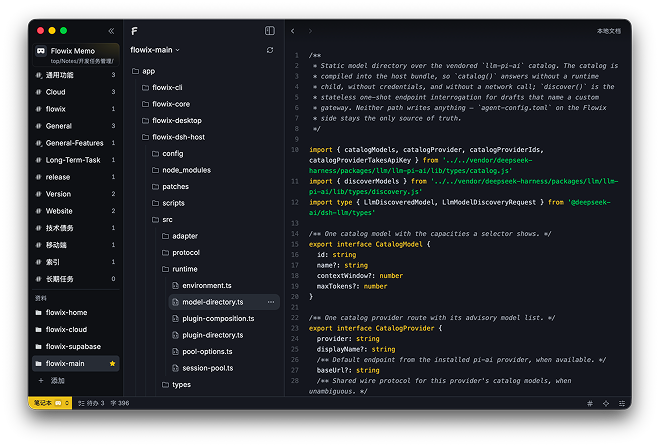 Code file browsing and editing |
Quick start
- Download and install Flowix from the website.
- Create a new local folder, or register an existing folder as a notebook.
- Create a document and write down the task background, reference materials, goals and constraints.
- Call an agent from within the document, or keep organizing content with tags and properties.
Local development
git clone https://github.com/text2future/flowix.git
cd flowix
npm install

npm run tauri dev
npm run dev
npm run tauri build
The development environment requires Node.js 20+, Rust 1.75+ and Tauri v2; the desktop app supports macOS 14+ and Windows 10+.
License
Flowix is open source under the MIT License.