Provides composable controls for self-evolving modes, including task states, thinking strategies, quality review, and human moderation for DeepSeek Harness Web.

- Language
- TypeScript
- License
- MIT
- Branch
- main
Install
$ dsh plugin --profile web add @graysilver/dsh-evolve-modesRun the command above in your terminal to install this plugin via the dsh CLI. You can switch Profile in the top-right corner. New to dsh? Read the beginner tutorial
Install via your agent
Install the DeepSeek Harness plugin GraySilver/dsh-task-modes for me: review the repository at https://github.com/GraySilver/dsh-evolve-modes first, then run the install command and verify the plugin loads successfully.
Paste this instruction to the DSH Web GUI assistant — it will install and verify for you.
One-Line Positioning
dsh-evolve-modes is a DeepSeek Harness web plugin that combines four dimensions—working state, thinking strategy, quality gates, and self-evolution—into a compact control next to the input area, allowing users to combine agent working modes by task rather than by persona, and supports global rule learning based on completed sessions with human oversight.
Core Capabilities
- Display and switch working state (Execute / Plan), thinking strategy (Standard / First Principles), quality gates (Off / Adversarial Review / Acceptance Review), and self-evolution (Off / Proposal) as four independent dimensions next to the input area
- When First Principles is enabled, inject explicit goal-fact-assumption-constraint-derivation-verification segments into the system prompt and leave traceable historical evidence in Trajectory
- Launch an independent forked sub-agent for adversarial or acceptance review after the parent agent completes its response, and render the Markdown report below the corresponding response
- In Plan mode, limit executable tools via a tool whitelist (read-type tools + platform shell + exit_plan_mode), rejecting all other tools directly
- Learn in isolation from completed sessions at a default rhythm of once every 3 parent responses, generating evidence-backed pending review proposals that require manual Apply to become approved global rules
- Provide a Self-evolution mode settings page to view pending proposals, add/edit/delete approved rules, restore from backup, view learning execution records and failure reasons
Technical Implementation
- Language: TypeScript + React (server entry at src/index.ts, client UI at src/client/index.tsx)
- Key Dependencies: @deepseek-ai/cordis (plugin injection and effects), @deepseek-ai/dsh-storage-domain (persistent storage domain), @deepseek-ai/dsh-subagent (forked sub-agents), @deepseek-ai/dsh-typert-protocol (remote service description)
- Architecture Pattern: Plugin ID and default shellTool declared via cordis.patch.yml; Host side uses ctx.inject to subscribe to agentPresets/commands/llm/systemPrompt/subagents/storageDomain/tools at once, then separately registers systemPrompt sections,
tools/pre-executehooks,evolve-mode/evolve-mode-reviewcommands, andagent/turn-stoppinglisteners; Client side injects conversation.input.left control, conversation.input.plan slot, conversation.chat.turnTail review report via slots, and exposes 5 settings interfaces through Typert Remote - Entry Files: src/index.ts:apply (Host entry), src/client/index.tsx:apply (Client entry), src/typert.ts / src/remote.ts (Typert definitions)
Applicable Scenarios
Users who need the agent's working mode to flexibly combine by task: use "normal + standard + off" for daily tasks to maintain speed, switch to "plan + first principles" for high-risk decisions, enable "adversarial or acceptance review" after delivery for independent sub-agent result checking; if long-term stable preferences and identity information should be accumulated, enable self-evolution, where the plugin learns in fixed batches and generates pending rules requiring approval.
Prerequisites and Compatibility
| Dependency | Minimum Version | Description |
|---|---|---|
| DeepSeek Harness | 0.1.0-rc.6 | Requires web plugin loader, client UI slots, storage domain, direct llm service, forked subagent, official planMode service, and tools/pre-execute pipeline |
| Node.js | ^22.19.0 or >=24.0.0 | From package.json engines field |
| @deepseek-ai/cordis | ^4.0.1-rc.1 | peerDependencies |
| @deepseek-ai/dsh-* | rc.1 / rc.5 | 11 peer dependencies, must be provided by host profile |
| React | ^18.2.0 | Client UI dependency |
| Platform | macOS / Windows / Linux | Default shellTool is pwsh on Windows, bash on other platforms, determined by process.platform in cordis.patch.yml |
| Native Modules | None | Uses only node:crypto at runtime, no node-pty / node:sqlite native dependencies |
Installation
dsh plugin --profile web add @graysilver/dsh-evolve-modes
Configuration Options
| Configuration | Type | Description | Default Value |
|---|---|---|---|
| shellTool | 'bash' | 'pwsh' | Platform shell allowed in Plan mode tool whitelist, automatically selected by cordis.patch.yml (pwsh on Windows, bash elsewhere); only takes effect when target profile has registered corresponding shell | Cross-platform auto: Windows → pwsh, others → bash |
The plugin's runtime behavior (learning batches, pending proposal limits, current state of each dimension) is managed through the Self-evolution mode settings page and
/evolve-modecommand, not via host yaml configuration.
FAQ
Q: After installation, where can I find this plugin's controls?
A: After restarting the web profile, the self-evolution mode control appears on the left side of the input area (conversation.input.left slot), and the self-evolution settings entry is in the top-level Settings page under the Self-evolution mode section.
Q: Will the plugin modify DeepSeek Harness core code?
A: No. cordis.patch.yml only inserts the plugin's own injection description, and plugin state is saved in its own storage domain, not modifying AGENTS.md or CLAUDE.md.
Q: How many additional model calls do adversarial review / acceptance review add?
A: Each time the parent agent completes a response, the quality gate triggers an extra forked sub-agent call to generate a Markdown review report; self-evolution analysis triggers an isolated LLM call each time a learning batch completes (default: once every 3 parent responses).
Q: Do self-evolution mode rules take effect automatically?
A: No. Learning results only generate pending review proposals that must be manually clicked Apply in the Self-evolution mode settings page to become approved rules, which are then injected into subsequent system prompts through a tagged <dsh-evolve-modes-learned-instructions> segment.
Q: What context from the parent session does the learning request read?
A: Learning requests are isolated: they use an independent persona and system prompt, don't inherit parent session history or parent agent working context, carry no tools, don't create learning sub-agents, and don't load the source working directory's AGENTS.md/CLAUDE.md.
Q: Where is data stored? How to uninstall?
A: Session-level state lives in graysilver_dsh_evolve_modes storage domain, while cross-session self-evolution rules/proposals/backups/learning records live in graysilver_dsh_evolve_modes_evolution domain; after uninstalling via dsh plugin remove, data remains in host storage.
Q: What's the relationship with DSH's built-in plan mode?
A: The plugin directly reuses the official @deepseek-ai/dsh-plan-mode service and exit_plan_mode approval flow, and limits available tools in plan mode through tools/pre-execute without implementing a duplicate plan system.
Q: Will old version session records migrate automatically?
A: Yes. 0.3.x copies data from graysilver_task_modes and graysilver_task_modes_evolution legacy domains, maps old single-mode aliases to new fields, and won't overwrite existing data in new domains.
Learning Curve
Entry-level — the control mounts directly to the input area with working defaults; only requires understanding the "four independent dimensions" mental model without configuring any host yaml.
Known Issues and Limitations
- Platform shell is fully functional in plan mode, relying solely on prompt-based review agent suggestions not to modify files, not OS-level sandbox; configure restricted shell or external sandbox for process isolation (README.md:191-201 / README.en.md:109-111)
- Each completed parent response with quality gate enabled adds one model call and corresponding delay, and reviews don't automatically run project test/lint/build (README.en.md:123)
- Self-evolution analysis requires the session to have parsed provider and model, otherwise throws error and logs failure to learning runs (src/evolution/learning.ts:49-51)
- Assistant messages only serve as context and cannot individually become rule evidence; when exceeding 2000 characters, only first and last 1000 are retained (src/evolution/messages.ts:4-16, README.md:91)
- Approved rules are global and not bound to project directory; project-level scope no longer supported from 0.3.x (src/types.ts:21-23, README.en.md:103)
- Each self-evolution analysis run uses the parent session's provider/model with no independent model routing configuration



让 Agent 的工作方式可组合、可审查、可持续改进,最终实现 Agent Self Evoling。
dsh-evolve-modes 是 DeepSeek Harness 的独立 Web 插件。它在输入区提供一个紧凑的工作流控制项,让你组合 Agent 的工作状态、思考策略、质量门禁和自进化行为。
插件不 fork DeepSeek Harness,不复制 Agent loop,也不修改核心代码。安装后,当前任务使用的组合始终显示在输入区旁;全局“自进化模式”设置则负责管理跨会话的学习提议和已批准规则。

快速安装
推荐通过 npm 将固定版本安装到 DeepSeek Harness Web profile:
npx -y @deepseek-ai/dsh plugin --profile web add @graysilver/[email protected]
如果已经全局安装 DSH CLI,可以使用简写:
dsh plugin --profile web add @graysilver/[email protected]
也可以直接安装对应的 GitHub Release 包:
dsh plugin --profile web add https://github.com/GraySilver/dsh-evolve-modes/releases/download/v0.3.1/graysilver-dsh-evolve-modes-0.3.1.tgz
重启 Web profile 后,自进化模式控件会出现在输入区工具旁。打开顶层 自进化模式 设置即可管理全局学习规则。
需要审计源码或进行开发时,可以安装固定 Git revision:
dsh plugin --profile web add github:GraySilver/dsh-evolve-modes#<trusted-commit>
Git 安装包会执行安装期代码,请只安装可信 revision。
功能简述
输入区会显示当前组合,例如:
正常 · 标准 · 关 · 进化 开
点开控制项即可分别调整四个维度:
| 维度 | 选项 | 作用 |
|---|---|---|
| 工作状态 | 正常 · 计划 | 立即完成任务,或进入官方 DSH 计划工作流。 |
| 思考策略 | 标准 · 第一性原理 | 正常回答,或显式梳理目标、事实、假设、约束、推导和验证。 |
| 质量门禁 | 关 · 对抗性审查 · 验收审查 | 不增加审查,独立寻找风险,或对照任务和已批准计划验收结果。 |
| 自进化 | 关 · 开 | 自动分析会话,生成待人工审阅的规则提议,自动优化AGENTS.md(但不改动 AGENTS.md) |
这不是互斥的“人格模式”,而是每个任务都可以重新组合的一组工作决策。
自进化模式
自进化用于从多个已完成的 Agent 协作中识别稳定的用户身份、偏好和工作要求。它默认是 Propose(提议),只提出候选规则,不会自动改变后续行为。
默认设置
| 设置 | 默认值 | 说明 |
|---|---|---|
| 自进化 | Propose | 新会话和没有明确保存自进化选择的旧会话默认开启。 |
| 学习批次 | 3 | 每累计完成 3 次父 Agent 回复后启动一次学习。可在全局设置中调整为 1..100。 |
| 待审阅提议上限 | 100 | 超过上限时不会继续堆积提议,可在全局设置中调整为 1..1000。 |
| 学习范围 | 已开启自进化的源会话 | 不再配置项目范围;当前会话打开自进化,就会纳入学习范围。 |
| 规则作用域 | 全局 | 应用后的规则跨会话生效,不绑定项目目录。 |
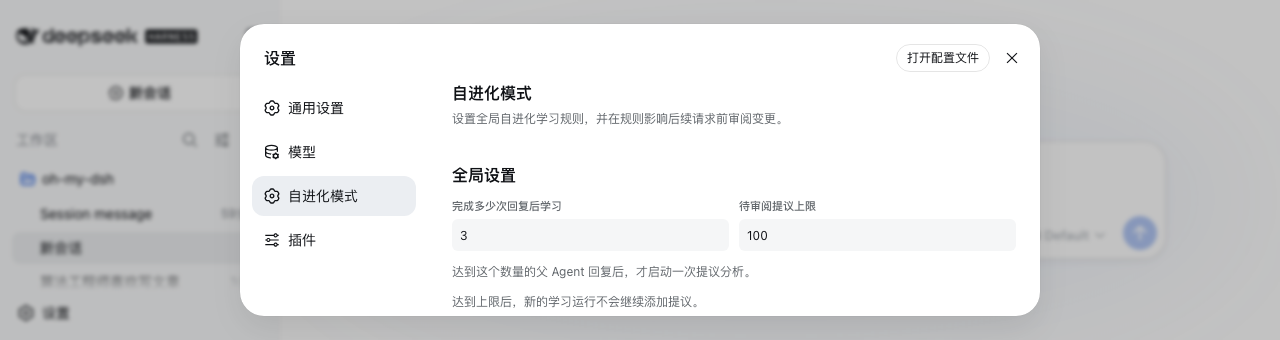
学习数据如何被整理
- 每个源会话最多取最近 100 条学习消息。
- 保留每轮完整的用户消息,以及该轮最后一个可见的助手消息。
- 助手消息只作为上下文;超过 2000 个字符时保留开头 1000 个字符和结尾 1000 个字符,中间以
...代替。 - 提议的证据必须逐字来自用户消息。助手的推断、一次性任务细节、实现结果、沉默或“没有再次提到”都不能单独成为规则证据。
学习请求是隔离的
每次学习都使用插件专用的单一 learning persona/system prompt,并把当前批次作为一条结构化 JSON 用户消息传入。学习请求:
- 不继承父会话历史;
- 不继承父 Agent 的工作型上下文;
- 不创建学习子 Agent;
- 不携带工具;
- 不加载源会话工作目录中的
AGENTS.md或CLAUDE.md; - 只分析可能长期有效的身份信息、偏好和工作要求。
学习失败会记录在设置页,未完成的批次会保留,方便之后重试;不会阻断父 Agent 的正常回复。
提议必须经过人工确认
完成 3 次父 Agent 回复
        ↓
隔离的学习请求
        ↓
待审阅提议
        ├─ 应用 → 写入全局 learned instructions
        └─ 忽略 → 不改变后续行为
在顶层 自进化模式 设置页中可以:
- 调整学习批次大小和待审阅提议上限;
- 查看每条提议的类别、推断类型和原始用户证据;
- 应用或忽略提议;
- 手工新增、修改和删除全局规则;
- 查看学习运行记录和失败原因;
- 从每次变更前自动创建的备份中恢复。
已批准规则会写入带有 <dsh-evolve-modes-learned-instructions> 标记的 system prompt section,并在 Trajectory 中投影相同内容。插件只使用自己的持久化存储,不会写入 AGENTS.md、CLAUDE.md 或任何项目文件。
为任务选择组合
| 你需要…… | 推荐组合 | 适合原因 |
|---|---|---|
| 快速完成日常工作 | 正常 · 标准 · 关 | 保持执行节奏,不增加额外流程。 |
| 做高影响决策 | 计划 · 第一性原理 · 关 | 先研究并暴露假设,再进入 DSH 的计划审批流程。 |
| 有把握地交付实现 | 正常 · 标准 · 验收审查 | 完成实现后,由独立审查 Agent 对照任务目标检查结果。 |
| 挑战高风险答案 | 正常 · 第一性原理 · 对抗性审查 | 显式展开推理,再寻找遗漏、反例、回归和缺少依据的结论。 |
| 沉淀稳定的个人偏好 | 正常 · 标准 · 关 · 进化 开 | 按默认每 3 次回复一批识别长期规则,只生成提议,不自动启用。 |
质量门禁
对抗性审查
在父 Agent 回复完成后启动独立审查 Agent,检查未满足要求、缺少依据的结论、遗漏、回归、反例和安全风险。它只报告证据、缺口和后续行动,不会静默改写、重试或修复父回复。
验收审查
对照任务、候选答案以及存在时的已批准计划进行验收。报告固定区分:
Met
Gap
Unverified
Evidence
Concrete follow-up
审查报告会显示在对应的助手回复下方。质量审查每个完成的父回复增加一次模型调用和相应延迟,但不会自动执行项目的 test、lint 或 build 命令。
第一性原理与计划
- 第一性原理:将目标、事实、假设、约束、推导和验证写入
request/header.system;Trajectory 会保留同一段指令作为可检查证据。关闭后只影响后续请求,历史证据不会被删除。 - 计划模式:委托给官方
@deepseek-ai/dsh-plan-modeservice,复用 DSH 的计划持久化和exit_plan_mode审批流程,不重复实现另一套计划系统。 - 工具策略:计划和质量审查通过 DSH 的
tools/pre-executepipeline 控制工具;默认允许read、glob、grep、read_image、已配置的平台 shell 和exit_plan_mode。这是一层工作流策略,不是操作系统级 sandbox。
命令
可在 Web 输入区或命令 API 使用:
/evolve-mode
/evolve-mode working execute
/evolve-mode working plan
/evolve-mode reasoning standard
/evolve-mode reasoning first-principles
/evolve-mode quality off
/evolve-mode quality general-review
/evolve-mode quality acceptance-review
/evolve-mode evolution off
/evolve-mode evolution propose
/evolve-mode evolution batch-size <1..100>
/evolve-mode evolution max-pending-proposals <1..1000>
/evolve-mode review <turn>
/evolve-mode reviews
旧的单一模式别名仍可迁移:normal、first-principles 和 adversarial-review。它们会把工作状态转换为执行,并按旧模式映射推理方式和质量门禁;当前自进化设置会保留。
配置与兼容性
bundle 会自动选择平台 shell。只有目标 profile 已注册该工具时才覆盖:
- id: dsh-evolve-modes
  config:
    shellTool: bash
质量审查要求 DSH 的 fork/subagent capability;自进化分析要求 DSH 的直接 llm service;计划模式要求官方 planMode service 和工具注册表。插件需要支持 Web plugin loader、client UI slots、storage domain、Trajectory 和上述 DSH 服务的 DeepSeek Harness 版本。
插件状态保存在自己的 storage domain,可跨服务重启和会话重新加载继续使用。0.3.0 会自动迁移旧版本的会话设置、提议、已批准规则、备份和学习记录,不会覆盖已经存在的新名称数据。
反馈
Bug 和功能建议请提交到 GitHub Issues。欢迎在 DeepSeek Harness Discussions 分享集成和使用反馈。
许可证
MIT
Read the usage guide →
Install steps, key points, FAQ and compatibility for this plugin — auto-derived from indexed fields.
Listing badge

[](https://deepseek-plugin.org/plugins/GraySilver/dsh-task-modes)Paste this markdown into your GitHub README to link back to this listing. The badge only states the listing — not a security endorsement.