Add an independent Claude provider type for DSH model settings, with gear levels based on model configuration, and support for Anthropic native model detection with pre-filled known model capacities.

- Language
- JavaScript
- License
- MIT
- Branch
- main
Install
$ dsh plugin --profile web add @mofeng2223/dsh-claude-providerRun the command above in your terminal to install this plugin via the dsh CLI. You can switch Profile in the top-right corner. New to dsh? Read the beginner tutorial
Install via your agent
Install the DeepSeek Harness plugin MoFeng2223/dsh-claude-provider for me: review the repository at https://github.com/MoFeng2223/dsh-claude-provider first, then run the install command and verify the plugin loads successfully.
Paste this instruction to the DSH Web GUI assistant — it will install and verify for you.
One-Sentence Description
Adds a standalone Claude provider type to DeepSeek Harness's model settings page, automatically writes RC8 native configuration, and supplements Anthropic native model detection with capacity pre-filling for common Claude models.
Core Capabilities
- Adds "Claude Provider" entry on the model settings page, managed separately from regular custom providers, allowing creation of multiple Provider IDs
- Separate thinking effort presets per model: five levels (low/medium/high/xhigh/max), four levels (low/medium/high/max), or toggle (off/high)
- Detects model list via Anthropic's native
GET /v1/modelsinterface, supports cursor pagination, can point to any compatible gateway - When detected model ID matches a recorded Claude model ID, automatically fills context window, max output length, and effort preset
- Only affects Provider IDs explicitly registered as Claude provider, does not modify built-in providers or other anthropic-messages custom routes
Technical Implementation
- Language: JavaScript (ESM,
"type": "module") - Key Dependencies:
@deepseek-ai/dsh-settings(injectssettingsandllmservices),@deepseek-ai/schemastery(declares settings schema),@deepseek-ai/dsh-client-ui-settings-models(devDependency only, used for building frontend patch client) - Architecture Pattern: Backend registers namespace to
ctx.settingsand configurable provider toctx.llmviaapply(ctx), wrapsllm.discoverModelsto route Claude provider through native Anthropic detection; frontend usescordis.patch.ymlto disable built-inui-settings-models, replacing it withlib/client.js(compiled fromscripts/build-client.mjswhich performs AST text replacement on upstreamdsh-client-ui-settings-models) - Entry Files:
src/index.js(backend apply/export),lib/client.js(frontend bundled artifact),scripts/build-client.mjs(build script)
Use Cases
Use this plugin when users want to manage Anthropic Claude series models (including those accessed via self-hosted or third-party Anthropic-compatible gateways) as a "dedicated provider" in DSH, and select thinking intensity per model. It replaces manual editing of settings.yaml and fills in the gaps where DSH's built-in UI doesn't yet provide Anthropic native model detection and capacity defaults for known models.
Prerequisites and Compatibility
| Dependency | Minimum Version | Notes |
|---|---|---|
| Node.js | >=22.19 | Declared in engines.node |
| DSH | 0.1.0-rc.8+ | Depends on @deepseek-ai/[email protected]; frontend patch based on [email protected], dsh version lower bound not explicitly specified in manifest |
| Platform | Cross-platform | Injects web client via cordis, no platform restrictions |
| Native Modules | None | No node-pty, node:sqlite, or other native modules introduced |
Installation
dsh plugin --profile web add github:MoFeng2223/dsh-claude-provider
Configuration
No additional configuration required. Recorded Claude models and their default capacities are hardcoded in the source code (CLAUDE_KNOWN_MODELS, including Fable 5, Opus 5/4.8/4.7/4.6, Sonnet 5/4.6, Haiku 4.5, etc.), and are automatically applied when creating new providers and models.
FAQ
Q: Do I need to manually edit settings.yaml after installation?
A: No. When saving the Claude provider in the frontend, the plugin calls DSH's native configuration write interface to persist fields like reasoning, reasoningEfforts, and compat.forceAdaptiveThinking to settings.yaml.
Q: Will it affect DSH's built-in Anthropic provider or regular custom providers?
A: No. The plugin does routing in the llm.discoverModels wrapper: only when a Provider ID is explicitly registered as claude-adaptive type under the dsh-claude-provider namespace does it use native Anthropic detection; the built-in anthropic route continues to use the upstream directory, and other anthropic-messages custom routes are not rewritten.
Q: Can I use self-hosted or third-party Anthropic-compatible gateways?
A: Yes. Model detection derives the /v1/models endpoint from the Messages API baseURL you provide, supporting any HTTP(S) address; API key is passed directly in the request or resolved from credential reference. Responses over 4 MiB are automatically aborted, with a maximum of 100 pages.
Q: Which thinking effort levels are available for each model?
A: Three preset options are provided: five levels (low/medium/high/xhigh/max), four levels (low/medium/high/max), and toggle (off/high). New models default to five levels, and Claude providers default to reasoning: high.
Q: Will uninstalling the plugin cause data loss?
A: No. Uninstalling does not delete ~/.dsh/settings.yaml or saved credentials. Existing Claude providers are downgraded to regular anthropic-messages routes, and native fields continue to work; only the dedicated Claude UI, model detection, and capacity pre-filling are lost.
Q: Can it work in CLI mode (without Web interface)?
A: The plugin supports --profile headless as well, but model detection and the dedicated UI depend on the Web client; frontend capabilities won't take effect in headless mode.
Q: What if I don't see the "Add Claude Provider" button after installation?
A: The cordis patch simultaneously sets the built-in ui-settings-models to disabled: true, replaced by this plugin's bundled lib/client.js. If the button is missing, please confirm the frontend client has been replaced and restart the DSH process.
Difficulty
Beginner — Installation immediately shows a new entry on the settings page. Usage only requires filling in baseURL, API key, and selecting a model; no need to understand schema details.
Known Issues and Limitations
- Model detection has a 4 MiB size limit on single responses and a 100-page hard limit on pagination (
src/index.js:18-19); exceeding these will throw an error - Only takes effect for Provider IDs explicitly registered as
claude-adaptive; users checking anthropic-messages protocol in regular custom providers won't get effort presets or capacity pre-filling - Built-in
anthropicprovider doesn't go through this plugin's detection, still uses the upstream directory (src/index.js:217) - Frontend capabilities are only enabled in the Web client; headless installation only retains backend schema registration and intercept points
English | 简体中文
DeepSeek Harness's general-purpose reasoning controls did not fully match the request parameters required by newer Claude models. As a result, selecting a reasoning level could either produce an HTTP 400 error or be silently mapped by the adapter to a different effective level—for example, Max in the interface could actually be sent as High. @mofeng2223/dsh-claude-provider added an explicit Claude provider type and sent the correct reasoning parameters for each Claude model.
DeepSeek Harness 0.1.0-rc.8 now supports reasoning-effort parameters for Claude models, but they still need to be configured manually in settings.yaml. Therefore, this plugin no longer intercepts or rewrites model requests at runtime. Instead, it writes the corresponding native settings to settings.yaml when a Claude provider is saved through the front end.
The plugin retains its dedicated Claude provider configuration page, so users do not need to edit settings.yaml manually. Anthropic-native model discovery, automatic defaults for common Claude models, and other features not yet available in DeepSeek Harness are also retained.
What this plugin does
-
Adds a dedicated Claude provider type
The Models settings page gains a separate Claude Provider form. You can create multiple Provider IDs under this type without mixing them with generic custom providers.
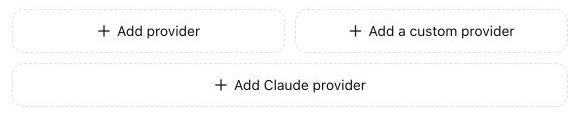
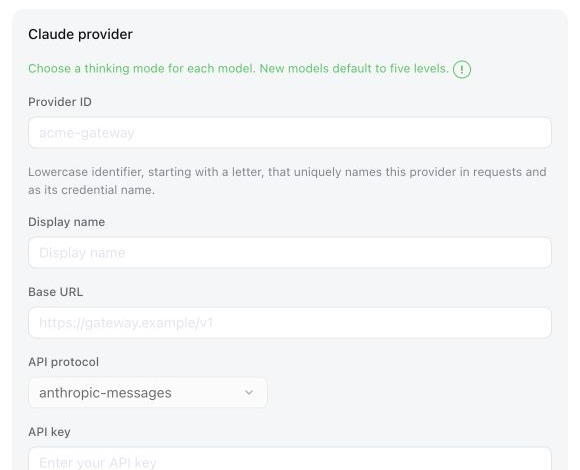
Selecting Add Claude Provider opens the dedicated Anthropic Messages form:
-
Adds model-specific reasoning modes
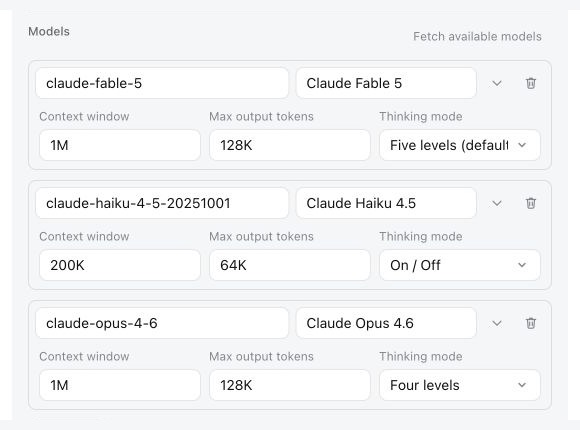
Each model can use one of three configurable mode sets:
- Five levels: Low, Medium, High, XHigh, and Max
- Four levels: Low, Medium, High, and Max
- Toggle: On or Off
New models default to five levels, and Claude providers default to High.
For adaptive thinking models, the plugin converted the selected level into Claude'sthinking.type: adaptiveandoutput_config.effortrequest format, preventing adapter rejections or silent downgrades.For adaptive thinking models, the plugin writes the selected level to DSH's native configuration when saved.
-
Adds native Anthropic model discovery
DeepSeek Harness's generic custom provider cannot list models for the
anthropic-messagesprotocol. This plugin adds model discovery for Claude providers through the provider's native Anthropic-compatibleGET /v1/modelsendpoint, including cursor pagination. -
Fills known Claude model defaults after discovery
When a discovered model matches a recorded Claude model ID, the plugin automatically fills its context window, maximum output length, and reasoning-mode set. Models entered manually remain fully editable and are not overwritten by this lookup.
-
Leaves every other provider unchanged
Discovery, defaults, and reasoning controls are limited to Provider IDs explicitly created as Claude Providers. DeepSeek Harness's built-in providers and ordinary custom providers keep their original behavior, even when they use
anthropic-messagesor expose aclaude-*model ID.
Install
Published package
Install the Web profile for the browser interface:
npx @deepseek-ai/dsh plugin --profile web add @mofeng2223/dsh-claude-provider
Install the Headless profile for command-line runs without the Web interface:
npx @deepseek-ai/dsh plugin --profile headless add @mofeng2223/dsh-claude-provider
Restart the corresponding DeepSeek Harness process after installation.
From source
Build and package the repository first:
git clone https://github.com/MoFeng2223/dsh-claude-provider.git
cd dsh-claude-provider
npm install
npm run build
mkdir -p dist
npm pack --pack-destination dist
Install the generated package into the Web profile:
npx @deepseek-ai/dsh plugin --profile web add ./dist/mofeng2223-dsh-claude-provider-*.tgz
Or install it into the Headless profile:
npx @deepseek-ai/dsh plugin --profile headless add ./dist/mofeng2223-dsh-claude-provider-*.tgz
Uninstall
Run the command for each profile where the plugin was installed:
npx @deepseek-ai/dsh plugin --profile web remove @mofeng2223/dsh-claude-provider
npx @deepseek-ai/dsh plugin --profile headless remove @mofeng2223/dsh-claude-provider
Uninstalling the plugin does not delete ~/.dsh/settings.yaml or stored credentials. Existing Claude providers remain ordinary custom anthropic-messages routes. Their reasoningEfforts, default reasoning, and compat.forceAdaptiveThinking fields are native RC8 settings, so adaptive thinking and the front-end reasoning-effort selector continue to work. Only the dedicated Claude add/edit UI, model discovery, and recorded defaults disappear.
License
Read the usage guide →
Install steps, key points, FAQ and compatibility for this plugin — auto-derived from indexed fields.
Listing badge

[](https://deepseek-plugin.org/plugins/MoFeng2223/dsh-claude-provider)Paste this markdown into your GitHub README to link back to this listing. The badge only states the listing — not a security endorsement.