Delegate tasks to DeepSeek Harness sub-agents within Claude Code/Codex, running them as native sub-tasks with real-time progress display.

- Language
- JavaScript
- License
- MIT
- Branch
- main
Install
$ dsh plugin --profile web add @zseven-w/dsh-crewRun the command above in your terminal to install this plugin via the dsh CLI. You can switch Profile in the top-right corner. New to dsh? Read the beginner tutorial
Install via your agent
Install the DeepSeek Harness plugin ZSeven-W/dsh-crew for me: review the repository at https://github.com/ZSeven-W/dsh-crew first, then run the install command and verify the plugin loads successfully.
Paste this instruction to the DSH Web GUI assistant — it will install and verify for you.
One-Line Positioning
dsh-crew is a plugin for the DeepSeek Harness (DSH) platform that enables Claude Code or Codex to dispatch tasks to DSH's DeepSeek agents while preserving the native subtask panel; it also adds image description and generation capabilities to the text-only DeepSeek model.
Core Capabilities
- Dispatch tasks to DSH agents at
flash/protiers, with real-time progress, current tool, and token usage displayed in Claude Code / Codex's native subtask panel - Support synchronous blocking calls (
dsh_run_worker) and asynchronous fan-out calls (dsh_spawn_worker), with the latter usable with status query and polling interfaces - When DSH Web instance is running (hub mode), dispatched tasks become DSH top-level sessions, viewable by working directory in the Web UI; otherwise automatically falls back to standalone runtime (available for CI, headless environments)
- Provide
describe_imageandgenerate_imagetools for text-only DeepSeek models, usable with local CLIs like Claude / Codex / Grok / Antigravity, or any OpenAI-compatible endpoint/local command - One-click installation to Claude Code and Codex: register local market, write MCP tool whitelist, integrate claude-hud status bar segment, backup all settings files before modifying
- Configurable tier policy (force flash-only or pro-only) and failure escalation (auto-retry with pro when flash fails), enforced at tool layer rather than by verbal agreement
Technical Implementation
- Language: TypeScript / JavaScript (ESM)
- Key Dependencies: @modelcontextprotocol/sdk, MCP stdio protocol; DSH SDK client (lazy-loaded on-demand for standalone mode only); zod (parameter validation)
- Architecture Pattern: Provides two forms simultaneously — MCP stdio server (
src/server.mjs) as a client-side shim for Claude Code / Codex; DSH Cordis host plugin (src/hub/index.mjs, mounted to DSH runtime viacordis.patch.yml) as the server-side; the two communicate via local loopback HTTP interface (/_dsh/dsh-crew/jobs) and auto-switch - Entry Points:
src/server.mjs(MCP entry),src/hub/index.mjs(DSH host plugin entry), outerpackage.json#dsh.bundle+cordis.patch.ymldescribe how to inject DSH Web profile
Use Cases
Developers who have subscribed to Claude Pro or regularly use Claude Code / Codex, and want Claude to actually "do the work" instead of just acting as a dispatcher: let Claude delegate independently solvable subtasks to DeepSeek agents while continuing to use their familiar Claude desktop workflow; and use DeepSeek for coding tasks in CI environments without a DSH Web interface. In developers' daily work, DSH models only support text; with the plugin, they can use locally logged-in Claude / Codex and other CLIs to help it "see images" and "draw".
Prerequisites & Compatibility
| Dependency | Minimum Version | Description |
|---|---|---|
| DSH | 0.1.0-rc.6+ | Plugin runs in DSH Web profile (hub mode) or coordinates with DSH 0.1.0-rc.6+ (standalone mode) |
| Node | Undeclared | Source only depends on Node built-in modules (fs/path/crypto/child_process, etc.) |
| Platform | Cross-platform | Only uses cross-platform Node API and subprocess calls; runs on macOS / Linux / Windows desktop systems |
| Native Modules | None | Runtime dependencies only include @modelcontextprotocol/sdk and zod; @deepseek-ai/* provided by host runtime |
| Claude Code / Codex | Host-dependent | Client integration requires Claude Code or Codex installed as the vehicle for dispatched tasks |
Installation
dsh plugin --profile web add github:ZSeven-W/dsh-crew
Configuration Options
| Config | Type | Description | Default |
|---|---|---|---|
| default_tier | flash / pro | Default agent tier for dispatch (V4 Flash is cheap and fast, V4 Pro has strong reasoning) | flash |
| default_effort | off / high / max | Default reasoning effort for dispatch | max |
| mode | auto / hub / standalone | auto prefers hub, falls back to standalone; hub forces host; standalone never connects to host | auto |
| default_timeout_seconds | Number | Maximum wait seconds per dispatch | 1800 |
| tier_policy | auto / flash-only / pro-only | Tool layer forces every dispatch to a single tier (overrides caller's tier) | auto |
| escalate_on_failure | Boolean | Whether to auto-retry with pro when blocking flash fails (based on actual failure, not pre-estimating difficulty) | false |
| preset_flash | String | DSH Agent preset for flash tier in hub mode (default follows host default) | minimal |
| preset_pro | String | DSH Agent preset for pro tier in hub mode | default |
| vision_provider | claude-code / codex / grok / agy / custom / off | Downstream provider for DeepSeek's image description capability | claude-code |
| vision_model | String | Specific model name passed to vision CLI | haiku |
| imagegen_provider | codex / agy / grok / custom / off | Downstream provider for DeepSeek's image generation capability | codex |
| hub_url | URL | Loopback address auto-detected in hub mode | http://127.0.0.1:3080 |
Configure via DSH Web settings page DSH Crew panel, or directly edit ~/.config/dsh-crew/config.json.
FAQ
Q: What additional configuration is needed after installation?
A: If DSH Web is running (hub mode), it already has DeepSeek credentials, and the plugin works directly. Only in pure standalone mode without a DSH instance do you need to write DEEPSEEK_API_KEY to ~/.config/dsh-crew/.env.
Q: DeepSeek is a text-only model; how about images and generation?
A: The plugin includes describe_image and generate_image tools, using locally logged-in subscription CLIs (Claude, Codex, Grok, Antigravity) or any OpenAI-compatible API/local command to handle image description and generation; images pasted into the session are automatically converted to text before being sent to the model.
Q: How to choose between dsh_run_worker and dsh_spawn_worker?
A: dsh_run_worker is a blocking call that returns with results; dsh_spawn_worker immediately returns a task ID, suitable for parallel fan-out, with results tracked via dsh_worker_status / dsh_worker_result.
Q: What's the difference between flash and pro tiers?
A: flash is fast and cheap, suitable for mechanical tasks; pro has stronger reasoning, suitable for complex tasks. You can use tier_policy to pin all dispatches to a single tier, or enable automatic retry with pro for failed flash tasks.
Q: How to uninstall?
A: Click the uninstall button in the DSH settings page DSH Crew section, or run node src/install/cli.mjs uninstall from command line; it will clean up Claude Code / Codex registration and HUD segments, while retaining backups of settings.json.
Q: What operating system is needed?
A: Only uses Node built-in modules and subprocesses; any desktop system that can run Node works, cross-platform on macOS / Linux / Windows.
Learning Curve
Beginner — After the plugin is attached to the DSH profile, you can dispatch via natural language like "dispatch X to ds-flash" directly in Claude Code / Codex; enter the DSH settings page to adjust when image description or preset changes are needed.
Known Issues & Limitations
- Client subtask shell is forwarded through Claude's own small model (haiku, etc.), consuming hundreds to thousands of additional Anthropic tokens per dispatch (from README original): either accept this cost, or work around it (the README mentions a router experimental route, but Codex side requires API key while subscription OAuth is blocked by upstream 403, not officially supported)
- Generated images are single-layer bitmaps; layer editing still depends on external tools like OpenPencil
- Codex roles must set
default_tools_approval_mode = "approve", otherwise tool calls are automatically cancelled - Client process and host process communicate via local loopback HTTP; polling requests waiting more than a few tens of seconds are cut off by Node undici's 300-second header timeout, so the plugin actively splits into ≤ 60-second slices during waiting (
src/hub-client.mjs:31-41), but extremely long tasks still require active polling viadsh_worker_result(wait_seconds) - When
imagegen_providerselects Codex/Grok/Antigravity CLIs, the corresponding CLI must be locally logged in; the plugin won't bypass their authentication

DSH Crew
A DeepSeek Harness plugin: dispatch work to DSH agents from Claude Code / Codex, without giving up the host's native subagent UI.
Native Progress UI • Tier Policy & Escalation • In-Host DSH Sessions • Vision & Image Generation • One-Click Install
npm: @zseven-w/dsh-crew · Current plugin release: 0.1.0-rc.3 · Tested with DSH 0.1.0-rc.6
English · 简体中文 · 繁體中文 · 日本語 · 한국어 · Français · Español · Deutsch · Português · Русский · हिन्दी · Türkçe · ไทย · Tiếng Việt · Bahasa Indonesia

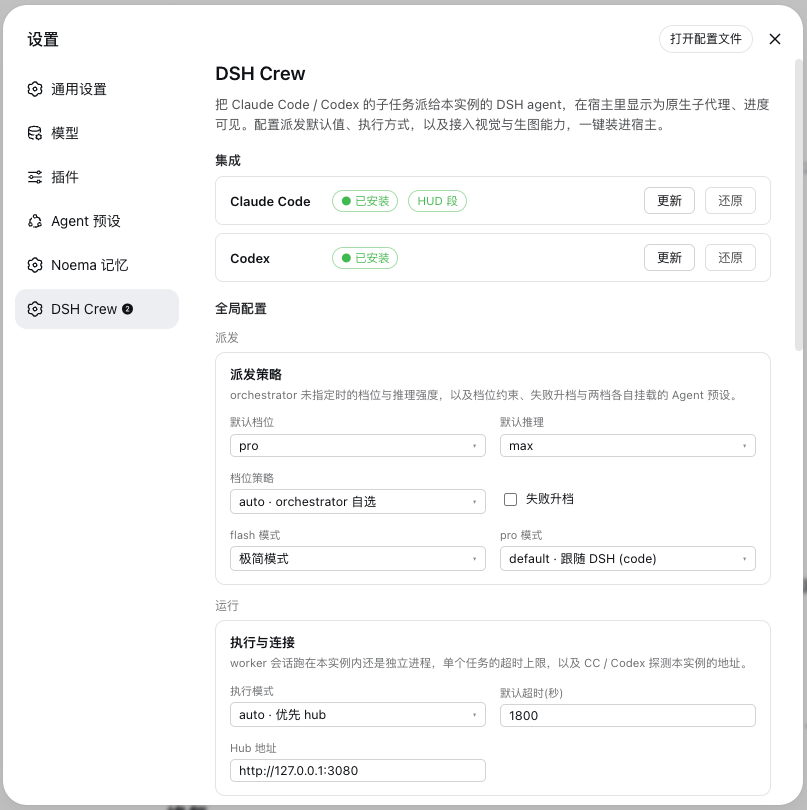
The DSH Crew settings page — host integrations, dispatch policy, execution and the multimodal bridge
Why DSH Crew
DSH Crew is a plugin for DeepSeek Harness (DSH) — an open-source agent harness. It makes DSH agents dispatchable from Claude Code and Codex: the orchestrator keeps its own model, the work runs on a real DSH agent with that harness's tools, sandbox, presets and session history, and the host still shows it as a native subagent with live progress.
What runs the work is a DSH agent, not a bare model call. Tiers (flash / pro) select how much capability that agent gets from the harness's configured roster — DeepSeek V4 Flash and V4 Pro today — so a change of model in DSH needs no change here.
🧵 Native Progress UIWorkers appear as regular subagents in Claude Code / Codex — dispatch count, running step, tool calls and token usage all show up in the host's own task panel, plus a claude-hud statusline segment: |
🎚️ Tier Policy and Escalation
|
🏛️ In-Host DSH SessionsWith the bundle installed in a DSH profile, each worker is a first-class DSH session: visible in the Web UI, grouped by working directory, mounted with the Agent preset you choose per tier. Without DSH running, dispatch falls back to a standalone DSH runtime, so CI and headless environments still work. |
👁️ Vision and Image GenerationDSH's models are text-only. |
🔌 Custom ProvidersBring your own endpoint (Base URL + API key + models) or a local command template. Each provider has a connectivity test that checks reachability and auth, then makes one real vision call so you find out now, not mid-task. |
📦 One-Click InstallThe settings page installs and updates the Claude Code plugin and the Codex role files for you — marketplace registration, permission allowlist, HUD wiring, absolute paths rendered for this machine — and restores them just as easily. Every settings file is backed up first. |
How it works
Claude Code / Codex (orchestrator, keeps its own model)
  └─ ds-flash / ds-pro  ← native subagent shell (progress shows in the host's task UI)
       └─ MCP: dsh_run_worker(tier, effort, cwd)
            ├─ hub reachable → session inside DSH (visible in the Web UI, grouped by cwd)
            └─ otherwise     → dsh-jsonrpc-agent runtime (worker.cordis.yml)
                 └─ DeepSeek V4 Flash / Pro (DSH SDK, event stream → progress and token stats)
One run, two views
Dispatch fans out. Below, eighteen workers translate this README in parallel: the host counts them as its own subagents, while the harness runs them as real sessions.
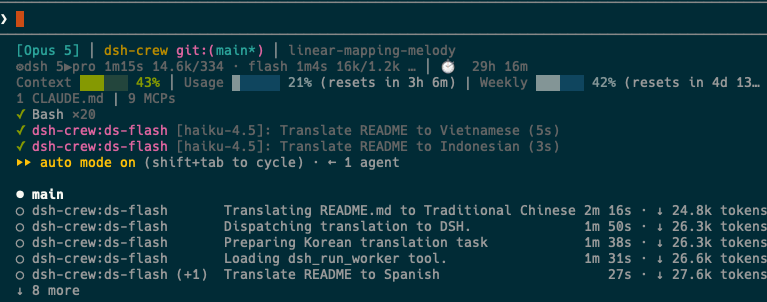
Claude Code sees dsh-crew workers as native subagents, with a statusline segment tracking running tiers, elapsed time and tokens.
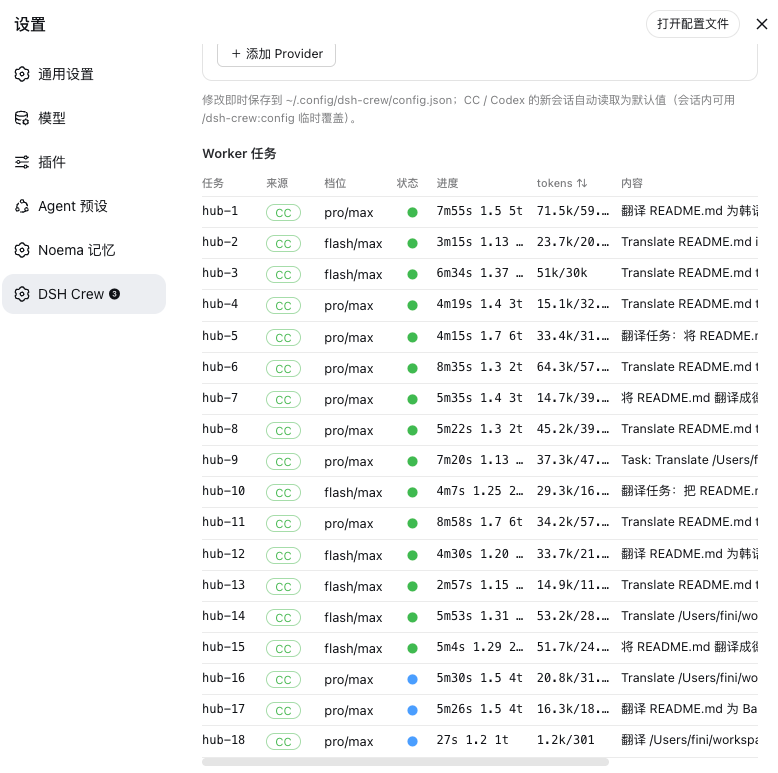
The DSH Crew panel sees the same run from the harness side: which host dispatched each job, its tier and effort, live progress and token usage.
Install
Install into a DSH profile from npm:
dsh plugin --profile web add @zseven-w/dsh-crew@latest
dsh web
Or, for local development straight from the source tree:
dsh plugin --profile web add link:/path/to/dsh-crew
dsh web
The link: protocol symlinks the profile dependency to this repository, so rebuilds are visible immediately.
Configure DeepSeek credentials (standalone only)
In hub mode — the installation above — workers run inside the DSH instance and use the DeepSeek credentials it is already configured with. Nothing else to set up.
Only the standalone fallback needs a key of its own: dispatching from Claude Code / Codex with no DSH instance running launches a worker runtime as a separate process. Obtain an API key from platform.deepseek.com and write it to ~/.config/dsh-crew/.env:
DEEPSEEK_API_KEY=sk-...
Verify
node scripts/smoke.mjs
The smoke test dispatches one cheap job through whichever path is available — the hub when a DSH instance is running, standalone otherwise — and prints which one it used. Within about ten seconds you should see smoke test passed — configuration OK. On failure the reason is printed, scoped to the path that was tested.
Then open Settings → DSH Crew and install the Claude Code / Codex integrations with one click.
Background and terminology
- DSH (DeepSeek Harness): DeepSeek's open-source agent harness, a code agent in Web UI form, similar to Claude Code but driving DeepSeek models.
- MCP (Model Context Protocol): Anthropic's AI tool integration protocol, enables LLMs to safely call external tools and data sources.
- Cordis bundle: DSH's plugin format; this project can run standalone as an MCP service or install into DSH Web as hub mode.
- tier: capability tier — which slot of DSH's configured model roster a worker gets.
flashis fast and cheap (simple tasks),proreasons harder (complex problems). Today they map to DeepSeek V4 Flash and V4 Pro; swap models in DSH and nothing changes here. - worker: the DSH agent doing the work — a full session with its own tools, sandbox and preset, not a bare model call.
- effort: reasoning strength,
off= no reasoning,high= high reasoning investment,max= maximum reasoning investment.
Claude Code
Installation
One-click installation (choose one):
- DSH settings page (when hub mode is installed): Settings → DSH Crew → "Install to Claude Code"
- Command line:
node src/install/cli.mjs all
Both do the same thing: register local marketplace (parent directory dsh-plugins/ as marketplace root) + claude plugin install + MCP tool permission allowlist + claude-hud worker status segment config (auto-backup settings.json before changes, idempotent). Restart the session after installation for changes to take effect.
Usage
- Directly in conversation, say "dispatch X to ds-flash" or "dispatch X to ds-pro", and subagent executes the task
- Dispatch count and real-time progress shown in Claude Code task UI
- HUD status line segment:
⚙dsh 1▶pro 2m14s 21.7k/606 ✓3(current tier / elapsed time / token usage / completion count)- For local development,
statusline/statusline.shorstatusline/worker-segment.shcan be independently integrated
- For local development,
- Long-running tasks: CC has timeout limits on MCP calls (
MCP_TOOL_TIMEOUTadjustable), long tasks can have orchestrator usedsh_spawn_worker+dsh_worker_result(wait_seconds)polling - Local development and debugging:
claude --plugin-dir /path/to/dsh-crewto temporarily load
Session commands
These override the global defaults for the current session only, and are enforced at the tool layer rather than by prompting:
| Command | What it does |
|---|---|
/dsh-crew:config | Show or set this session's defaults: tier=flash|pro, effort=off|high|max, mode=auto|hub|standalone, timeout=<seconds>, policy=auto|flash-only|pro-only, escalate=true|false, reset |
/dsh-crew:on · /dsh-crew:off | Turn dispatch for this session on or off (off is a hard switch: the tool refuses) |
/dsh-crew:status | Live status of worker jobs: tier, progress, tokens, current tool |
Codex
Installation
Recommended to use the installer (auto-renders paths for this machine, copies /dsh-config, /dsh-status commands):
node src/install/cli.mjs codex
Or manually copy (requires manual path modification after copying):
cp codex/agents/*.toml ~/.codex/agents/ # global or project-level .codex/agents/
Role files come pre-configured with:
- MCP server mounting configuration
default_tools_approval_mode = "approve"(required, otherwise tool calls are auto-cancelled in exec mode)tool_timeout_sec = 3600
Note: When manually copying, absolute paths in the args field must be updated to match actual installation location; the installer handles this automatically.
Usage
- In interactive TUI, select "spawn ds-pro to ..." to dispatch tasks; Active/Done panels show progress
codex execmode can also directly calldsh_run_worker
Session commands
The same two prompts are installed for Codex:
| Command | What it does |
|---|---|
/dsh-config | Show or set this session's defaults: tier=flash|pro, effort=off|high|max, mode=auto|hub|standalone, timeout=<seconds>, policy=auto|flash-only|pro-only, escalate=true|false, reset |
/dsh-status | Live status of worker jobs: tier, progress, tokens, current tool |
MCP tools
| Tool | Description |
|---|---|
dsh_run_worker | Synchronous task dispatch (tier: flash/pro, effort: off/high/max, cwd), waits for result |
dsh_spawn_worker | Asynchronous task dispatch, returns job id (for parallel fan-out) |
dsh_worker_status | Query real-time progress of all jobs (turn/step/current tool/token) |
dsh_worker_result | Fetch result, can specify wait_seconds to wait |
dsh_worker_cancel | Cancel specified job, terminate its runtime process |
Progress is simultaneously mirrored to ~/.config/dsh-crew/status.d/ (one shard file per writer, can be read by statusline / external monitoring).
Multimodal: vision and image generation
DeepSeek is a text-only model and does not support image input or generation. This plugin sources these capabilities externally through MCP tools:
| Tool | Description |
|---|---|
describe_image | Answer questions by viewing images (screenshots, designs, charts, etc.), results cached by provider + model + image + question |
generate_image | Generate image from text description, save to specified absolute path; output is flat bitmap (requires OpenPencil for layer editing) |
Session image pasting: In DSH, switch model to DeepSeek (vision) ◉ to directly paste images. Images remain in session and display normally; the plugin appends transcribed text after them and strips images before sending—you see the image, the model reads the text.
Configuration
In DSH settings page → DSH Crew → Multimodal (or directly edit ~/.config/dsh-crew/config.json):
Vision provider (image viewing):
claude-code(default, uses haiku, inexpensive)codex(uses GPT, can specify specific model)grok(uses Grok)agy(Antigravity)custom(OpenAI-compatible API or local command)off(disabled)
Image generation provider (image generation):
codex($imagegen, gpt-image-2)agy(Nano Banana)grok(Imagine)custom(OpenAI-compatible API or local command)off(disabled)
Custom provider
Two integration methods:
API: Any OpenAI-compatible endpoint
- Fill Base URL, API Key, model list
- Vision uses
/chat/completionswith inline base64 images - Image generation uses
/images/generations - Must specify "image generation model" to have generation capability, otherwise provider only appears in vision selection
CLI: Local command template, placeholders substituted with safe references
- Vision:
{image} {question} {model}→ stdout as answer - Image generation:
{prompt} {output} {size}→ command must write file to{output} - Fill at least one command; whichever is filled determines capability
Connectivity test: Each custom provider has a test button
- API: Check endpoint reachability, auth, send real vision request to verify
- CLI: Check executable file, run real command to verify
- Image generation: Validate config only, no actual image output
Borrowed subscription CLIs (claude / codex / grok / agy) require you to be logged in locally; the plugin won't bypass their permissions for you.
Hub mode
This package is also a valid DSH bundle (dsh.bundle + cordis.patch.yml). After installing into DSH Web profile with dsh plugin add dsh-crew:
- Worker sessions become first-class citizens: run as first-class sessions in DSH host (
agents.create+ per-session model/effort waterfall + default preset), appear in Web UI session list, can be opened anytime to view complete execution - Organize by working directory: manage worker sessions by cwd in Web UI
- Loopback API:
POST/GET /_dsh/dsh-crew/jobs: spawn tasks, list, long-poll results, cancelGET /_dsh/dsh-crew/ping: health check (MCP shim uses this to detect if hub is running)POST /_dsh/dsh-crew/install: one-click install Claude Code / Codex integration (backend ofsrc/install/)
- Auto-detection: CC/Codex's MCP shim auto-detects hub (
DSH_CREW_HUBenv var, defaulthttp://127.0.0.1:3080)- DSH Web running → jobs enter hub mode (
mode: "hub") - Not running → fall back to standalone runtime
- DSH Web running → jobs enter hub mode (
Solution selection and limitations
Regular subscribers → shell subagent approach (recommended)
- Current state: Claude Code subagent shell uses haiku as intermediary; each dispatch adds hundreds to thousands of tokens
- Trade-off: Use small amount of Anthropic token in exchange for native task UI, real-time progress display, no extra configuration
- Recommendation: If you already subscribe to Claude Pro or use Claude Code, use this approach—convenient and transparent
Pay-as-you-go / CI environments → direct router approach
- Current state: Claude Code subagent frontmatter doesn't support direct third-party model connection; this repo's router experiment in scratchpad requires API-key credentials for Claude Code, but subscription OAuth is blocked upstream by Anthropic with 403
- Recommendation:
- If using API-key credentials (not OAuth) and want to save Anthropic tokens, can run local router for direct DeepSeek connection
- CI environments typically also use API keys; this approach is more economical (all DeepSeek tokens)
- Requires self-testing of router integration (not officially supported)
Running DSH Web → hub mode auto-enabled
- Current state: If
dsh plugin add dsh-crewinstalled into DSH Web profile, jobs run as first-class sessions in host, appear in Web UI session list - Recommendation: During local development iteration, recommend enabling hub mode; worker progress can be fully observed in Web UI; for cross-machine collaboration or environments without Web UI, use Claude Code / Codex shell approach
Known items
- Codex role can theoretically try
model_providerpointing directly to DeepSeek (unverified); this bridge doesn't depend on it - Image generation output is flat bitmap; layer editing requires OpenPencil
- Runtime dependencies: Only
@modelcontextprotocol/sdkandzod;@deepseek-ai/*are host runtime, provided by the DSH host (a plain npm install never pulls them) - Codex must configure:
default_tools_approval_mode = "approve", otherwise tool calls are auto-cancelled
Develop
pnpm install
node_modules/.bin/tsdown src/client/index.tsx --format cjs --platform browser \
  --target es2022 --tsconfig tsconfig.client.json --out-dir .client-build --clean
node scripts/build-client.mjs   # wraps the bundle for the DSH module loader
node scripts/smoke.mjs          # dispatches one real flash task end to end
Runtime dependencies are only @modelcontextprotocol/sdk and zod; every @deepseek-ai/* package is host runtime provided by the DSH host (documented in the package's dshHostRuntime field, not in peerDependencies, so a plain npm install never pulls them), which keeps the plugin inside the host's single module realm.
Ecosystem
- DSH iOS — a live iOS Simulator and a USB-connected iPhone, inside the conversation
- DSH Noema — long-term memory for DSH
- DSH OpenPencil — inspect and edit
.opdesign documents inside a conversation
License
MIT
Read the usage guide →
Install steps, key points, FAQ and compatibility for this plugin — auto-derived from indexed fields.
Listing badge

[](https://deepseek-plugin.org/plugins/ZSeven-W/dsh-crew)Paste this markdown into your GitHub README to link back to this listing. The badge only states the listing — not a security endorsement.