Equip DSH Web with the Mnemon persistent memory backend, connecting session hot memory and project archives with Mnemon long-term storage as a three-layer supervised memory system.

- Language
- Go
- License
- Apache-2.0
- Branch
- master
Install
$ dsh plugin --profile web add github:mnemon-dev/mnemonRun the command above in your terminal to install this plugin via the dsh CLI. You can switch Profile in the top-right corner. New to dsh? Read the beginner tutorial
Install via your agent
Install the DeepSeek Harness plugin mnemon-dev/mnemon for me: review the repository at https://github.com/mnemon-dev/mnemon first, then run the install command and verify the plugin loads successfully.
Paste this instruction to the DSH Web GUI assistant — it will install and verify for you.
One-Line Positioning
mnemon turns DSH Web into an AI client with persistent memory: the host LLM remains the decision-maker, while the mnemon binary is responsible for precipitating conversations into local graph memory, which is recalled into context when the next session starts.
Core Capabilities
- Injects three layers of supervised memory into DSH sessions: DSH's built-in runtime hot memory, managed project archives, and Mnemon's long-term memory space
- Replaces database INSERT/SELECT with three primitives: remember/link/recall, aligning memory operations with the LLM's cognitive vocabulary
- Performs four types of relation searches on the graph (temporal, entity, causal, semantic), with automatic deduplication and conflict merging during recall
- Automatically preserves key continuity before session window compression, preventing early decisions from being squeezed out of context by long conversations
- Cross-session persistence: write once, all subsequent sessions can read from the default store
- Supports optional local Ollama vector retrieval, no internet required, no inference quota consumed
Technical Implementation
- Language: Go 1.24.6 (plus root package.json describing DSH assembly contract)
- Key Dependencies: modernc.org/sqlite (pure Go SQLite, no CGo), spf13/cobra (CLI framework), google/uuid, go.yaml.in/yaml/v3
- Architecture Pattern: Uses
cordis.patch.ymlto mount thedsh-mnemonsub-plugin to the DSH host; the plugin internally calls themnemonbinary on the host for storage and retrieval, with the host deciding write and recall between the binary and LLM - Entry Points: Declared by
cordis.patch.ymlon the DSH side; on the Go binary side, started bymain.go+cmd/memory/root.go
Use Cases
You frequently use DSH Web for cross-session continuous work (multi-round iterations, long-term refactoring, long-term client/project archives), but find important decisions and context always get compressed or forgotten. After installing mnemon, each new session will automatically recall the previous session's memory, and at the end you decide whether to persist it. If you also need to share memory between other runtimes like Claude Code / Cursor / Codex during daily development, you can also run mnemon setup --target <runtime>, which reads from the same ~/.mnemon database.
Prerequisites & Compatibility
| Dependency | Minimum Version | Description |
|---|---|---|
| mnemon binary | Same version as this repo (0.0.1) | Must be installed on the host first, otherwise DSH internal calls will fail |
| Node | >=20 | Declared in package.json engines.node |
| Operating System | macOS / Windows / Linux | Release configuration (release_distribution_test.go:45-50) covers linux/darwin/windows three platforms amd64 and arm64 |
| Native Modules | None | modernc.org/sqlite is pure Go implementation, no CGo toolchain required |
Installation
dsh plugin --profile web add github:mnemon-dev/mnemon
Configuration
DSH side plugin layer configuration (injected by cordis.patch.yml, adjustable in DSH's Plugin Config → Mnemon):
| Config | Type | Description | Default |
|---|---|---|---|
| routingGuidance | boolean | Whether Mnemon option appears in DSH routing guidance | true |
| lifecycleEnabled | boolean | Whether to enable session lifecycle hooks (Prime/Remind/Nudge/Compact) | true |
| recallMode | enum | Recall mode, guided lets host LLM decide when to recall | guided |
| writebackMode | enum | Writeback mode, guided lets host LLM decide when to persist | guided |
| idleReviewMs | integer | Polling interval for idle check (milliseconds) | 30000 |
| tabEnabled | boolean | Whether to show Memory System tab in session sidebar | true |
| writeEnabled | boolean | Whether to allow writing to long-term memory | true |
| timeoutMs | integer | Timeout for calling mnemon binary (milliseconds) | 10000 |
| defaultRecallLimit | integer | Default number of items returned per recall | 10 |
Environment variables on mnemon binary side (generally no need to modify):
| Environment Variable | Description | Default |
|---|---|---|
| MNEMON_DATA_DIR | Root directory for memory database | ~/.mnemon |
| MNEMON_STORE | Named memory store used by current session | default (or most recently activated named store) |
| MNEMON_EMBED_ENDPOINT | Local Ollama vector retrieval endpoint (only used when vector is enabled) | http://localhost:11434 |
| MNEMON_EMBED_MODEL | Ollama embedding model name | nomic-embed-text |
| MNEMON_EMBED_DIMENSIONS | Embedding vector dimensions | Undeclared, follows model default |
FAQ
Q: What needs to be installed on the system for this plugin?
A: You need to install the mnemon binary on the host first (recommended brew install --cask mnemon-dev/tap/mnemon or go install github.com/mnemon-dev/mnemon@latest). The DSH plugin side only connects mnemon to the Web client; without the main program, it won't work.
Q: Do I need to apply for an extra API Key?
A: No. Mnemon completely delegates memory judgment to the host LLM; the binary only handles the deterministic work of storage and retrieval; only when you additionally enable Ollama vector augmentation does it involve local models.
Q: Will memory be shared between different sessions?
A: Yes by default. All sessions share a store named default, write once and subsequent reads can all access it. If you need project-level isolation, use mnemon store create <name> to create a store, then mnemon store set <name> to switch, or temporarily start the process with MNEMON_STORE=work.
Q: Where do I go to customize memory judgment rules?
A: Edit ~/.mnemon/prompt/guide.md (mounted in DSH Plugin Config), which contains the human-readable rules for "when to recall, when to remember". SKILL.md only describes command syntax; don't mix them together.
Q: Can it be used on macOS/Windows/Linux?
A: The core memory functionality works on all three platforms. On Windows, the mnemon agency … command family is currently not available (source code cmd/agency/*.go is restricted with //go:build !windows), only the memory core is available. If you need Agency capability, please run on macOS or Linux.
Q: Do I have to start local Ollama?
A: No. Without Ollama, Mnemon only runs graph retrieval (four types of edges: temporal, entity, causal, semantic), and recall quality is already sufficient for daily use; enable Ollama only if you want vector similarity recall in addition.
Q: How to completely uninstall?
A: Uninstall dsh-mnemon in DSH's Plugin Config; then run mnemon setup --eject on the host, which will clear all hooks, skills and guide files distributed by runtimes.
Difficulty Level
Getting Started — just run one dsh plugin --profile web add … plus one line of mnemon setup on the host; default values already enable all common hooks and tabs, so regular users basically don't need to modify any configuration.
Known Issues & Limitations
- Windows currently does not support
mnemon agency …subcommand family (cmd/agency/serve.go:1,cmd/agency/setup.go:1, etc. restricted with//go:build !windows), only the memory core is available. - Depends on pre-installed mnemon binary on host; DSH plugin side does not include the binary, must install or link to the local version first.
- If Ollama vector augmentation is enabled, local Ollama service must be available and model name must match
MNEMON_EMBED_MODEL, otherwise it degrades to pure graph retrieval (functional but with reduced recall quality). - DSH's specific minimum compatible version is not declared in
package.json, needs actual verification on the Web side.

Mnemon
English | 中文
LLM-supervised persistent memory for AI agents.



LLM agents forget everything between sessions. Context compaction drops critical decisions, cross-session knowledge vanishes, and long conversations push early information out of the window.
Mnemon gives your agent persistent, cross-session memory — a four-graph knowledge store with intent-aware recall, importance decay, and automatic deduplication. The mnemon memory path remains one local binary with zero API keys and one setup command.
Mnemon ships one executable with two separate surfaces. Memory stays at the
mnemon root; Agency Preview lives at mnemon agency ... and adds
durable, project-local responsibility and effect admission to an existing Pi
agent. Agency does not replace Memory or the Agent Runtime.
Claude Max / Pro subscriber? Mnemon works entirely through your existing subscription — no separate API key required. Your LLM subscription is the intelligence layer. Two commands and you're done.
Why Mnemon?
Most memory tools embed their own LLM inside the pipeline. Mnemon takes a different approach: your host LLM is the supervisor. The binary handles deterministic computation (storage, graph indexing, search, decay); the LLM makes judgment calls (what to remember, how to link, when to forget). No middleman, no extra inference cost.
| Pattern | LLM Role | Representative |
|---|---|---|
| LLM-Embedded | Executor inside the pipeline | Mem0, Letta |
| File Injection | None — reads file at session start | Claude Code Memory |
| MCP Server | Tool provider via MCP protocol | claude-mem |
| LLM-Supervised | External supervisor of a standalone binary | Mnemon |
Mnemon also addresses a gap in the protocol stack. MCP standardizes how LLMs discover and invoke tools. ODBC/JDBC standardizes how applications access databases. But how LLMs interact with databases using memory semantics — this layer has no protocol. Mnemon's three primitives — remember, link, recall — form an intent-native protocol: command names map to the LLM's cognitive vocabulary (remember not INSERT, recall not SELECT), and output is structured JSON with signal transparency rather than raw database rows.
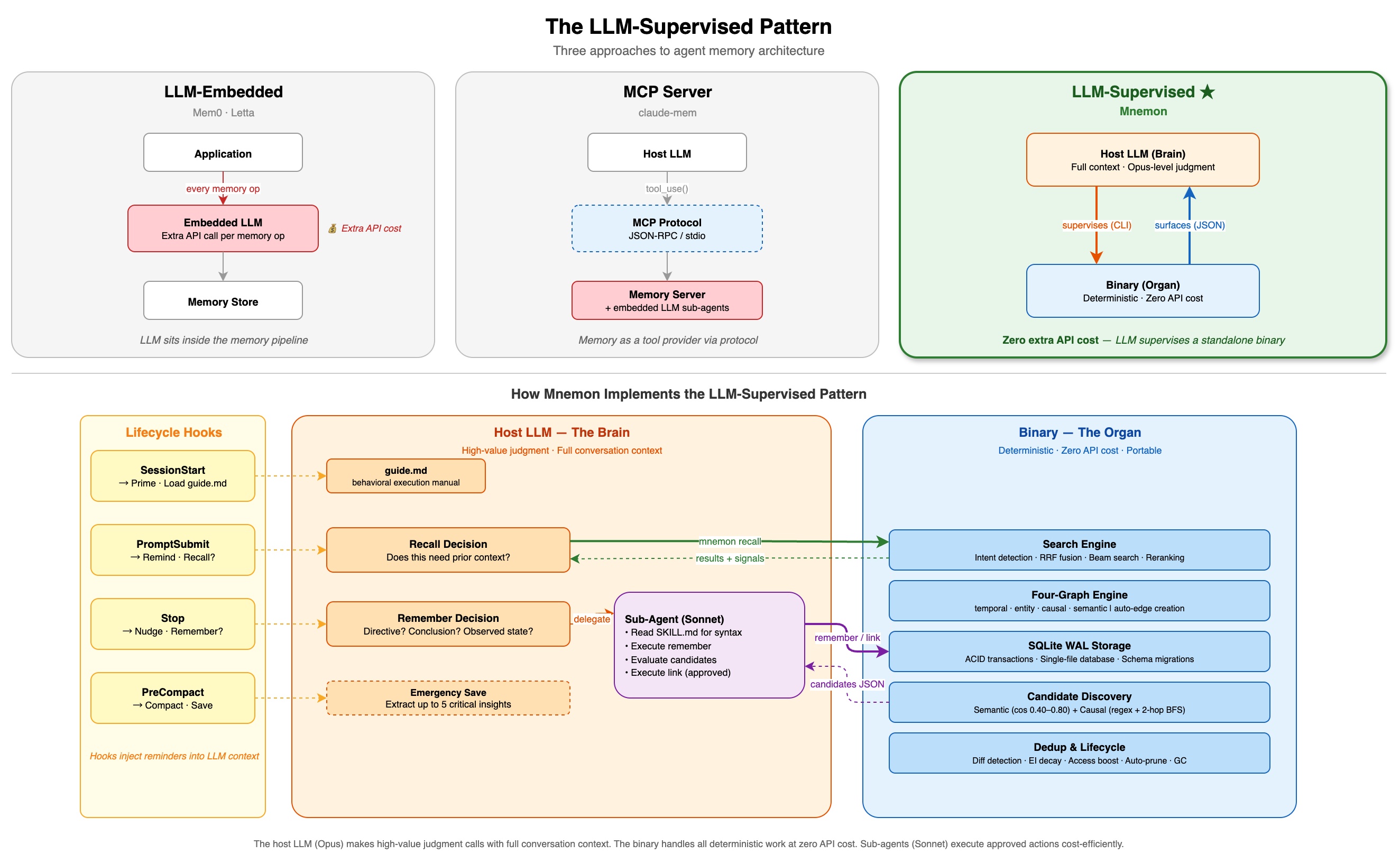
The LLM-Supervised pattern: hooks drive the lifecycle, the host LLM makes judgment calls, the binary handles deterministic computation.
Memory has a compound interest effect — the longer it accumulates, the greater its value. LLM engines iterate constantly, skill files cost nearly nothing to write, but memory is a private asset that grows with the user. It is the only component in the agent ecosystem worth deep investment.
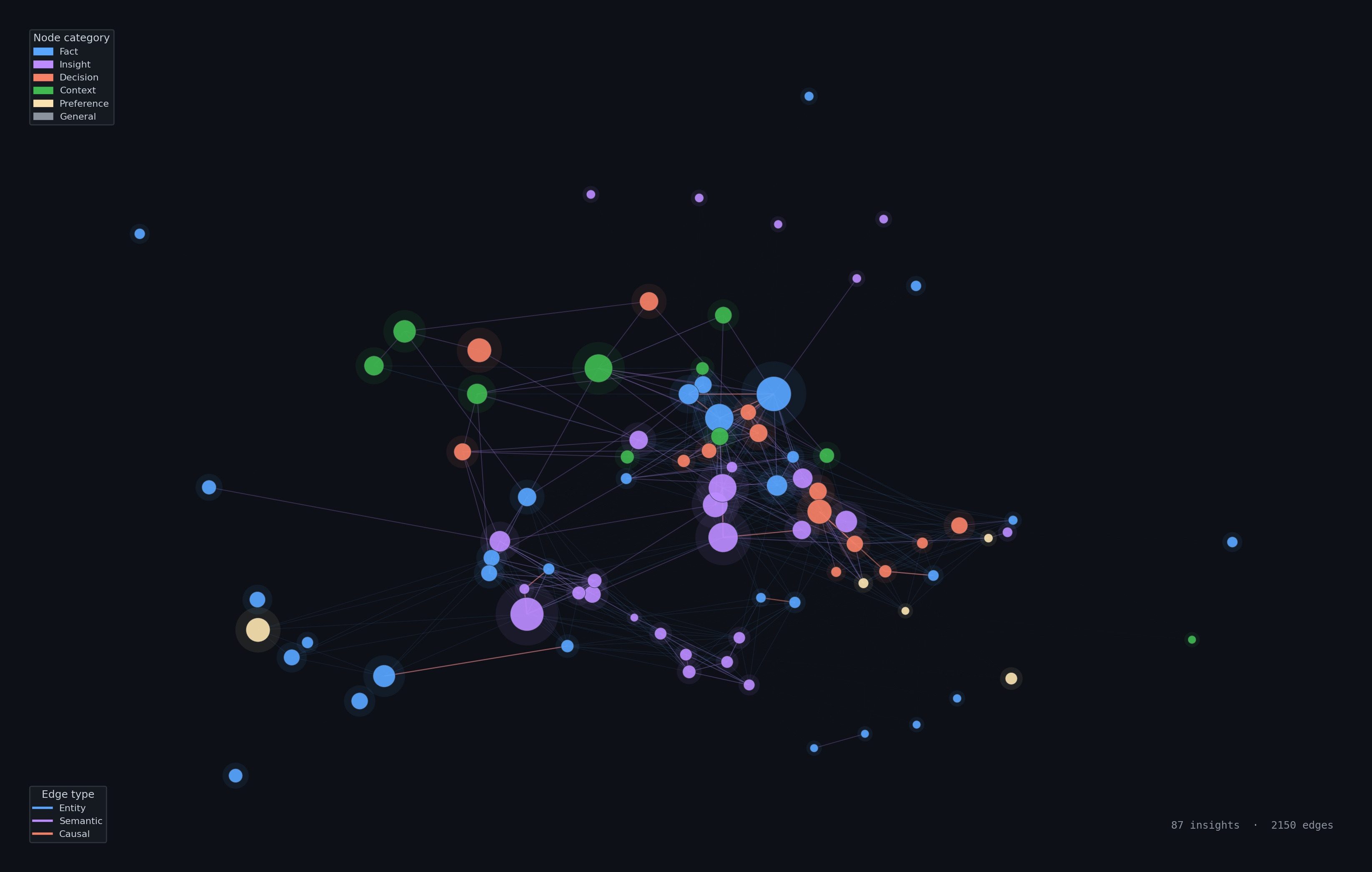
A real knowledge graph built by Mnemon — 87 insights, 2150 edges across four graph types.
See Design & Architecture for details.
Quick Start
Install
Homebrew Cask (macOS):
brew install --cask mnemon-dev/tap/mnemon
Go install (macOS / Linux / Windows):
go install github.com/mnemon-dev/mnemon@latest
Windows supports the core Memory commands. Agency remains unavailable on Windows until its local authority boundary has native Windows security.
From source (macOS / Linux):
git clone https://github.com/mnemon-dev/mnemon.git && cd mnemon
make install
Verify installation:
mnemon --version
mnemon agency --version
Agency (Preview · Pi-first)
mnemon agency setup --runtime pi --project-root .
Set up each project once, then use Pi normally. Agency is available on macOS
and Linux and remains independent from Memory: mnemon setup --target pi --yes
enables Memory, while the command above enables Agency. See the
Agency guide for its operating model, Preview compatibility
boundary, and optional peers.
Claude Code
mnemon setup
mnemon setup auto-detects Claude Code, then interactively deploys skill, hooks, and behavioral guide. Start a new session — memory just works.
Codex
mnemon setup --target codex --yes
One command deploys the mnemon skill, prompt files, and Codex lifecycle hooks
(SessionStart, UserPromptSubmit, Stop) in .codex/hooks.json.
Cursor
mnemon setup --target cursor --yes
One command deploys the mnemon skill, prompt files, and Cursor lifecycle hooks
to .cursor/. The integration primes new agent sessions with Mnemon guidance
and memory status, then nudges for durable-memory writeback after responses.
TRAE (TRAE Work)
mnemon setup --target trae --yes
One command deploys the mnemon skill, prompt files, and TRAE native hooks for
both TRAE IDE and TRAE Work to .trae/. The integration uses SessionStart,
UserPromptSubmit, and Stop hooks in .trae/hooks.json.
Qoder (QoderWork)
mnemon setup --target qoder --yes
mnemon setup --target qoderwork --yes
Qoder deploys the mnemon skill, prompt files, and native hooks to .qoder/
or ~/.qoder/. QoderWork uses its native user config at ~/.qoderwork/.
Both integrations register SessionStart, UserPromptSubmit, and Stop
hooks in settings.json.
CodeBuddy
mnemon setup --target codebuddy --yes
CodeBuddy deploys the mnemon skill, prompt files, and native hooks to
.codebuddy/ or ~/.codebuddy/. The integration registers SessionStart,
UserPromptSubmit, and Stop hooks in settings.json.
WorkBuddy
mnemon setup --target workbuddy --yes
WorkBuddy deploys the mnemon skill, prompt files, and native hooks to
.workbuddy/ or ~/.workbuddy/. The integration registers SessionStart,
UserPromptSubmit, and Stop hooks in settings.json.
Kimi Code
mnemon setup --target kimi --yes
Kimi Code deploys the mnemon skill, prompt files, and native lifecycle hooks to
~/.kimi-code/ or $KIMI_CODE_HOME/. The integration registers
SessionStart, UserPromptSubmit, and Stop hooks in config.toml.
OpenCode
mnemon setup --target opencode --yes
OpenCode deploys the mnemon skill to .opencode/skills/, registers the
generated guide through opencode.json instructions, and installs a native
plugin in .opencode/plugins/. The plugin injects recall context before chat
requests and adds Mnemon guidance to session compaction.
OpenClaw
mnemon setup --target openclaw --yes
One command deploys skill, hook, plugin, and behavioral guide to ~/.openclaw/. Restart the OpenClaw gateway to activate.
Pi
mnemon setup --target pi --yes
One command deploys the mnemon skill, prompt files, and a Pi TypeScript extension
to .pi/. The extension maps Mnemon's lifecycle reminders onto Pi events
(resources_discover, before_agent_start, agent_end,
session_before_compact). Start a new Pi session or run /reload to activate.
Hermes Agent
mnemon setup --target hermes --yes
One command deploys the mnemon skill, prompt files, and Hermes shell hooks to
~/.hermes/. The integration uses Hermes' native lifecycle hooks:
on_session_start, pre_llm_call, post_llm_call, and optional
on_session_finalize. Hermes may prompt once to approve the installed shell
hooks.
DeepSeek Harness
DeepSeek Harness (DSH) integrates through the dsh-mnemon plugin, which layers DSH's runtime memory, managed project documents, and Mnemon's long-term memory spaces into one supervised three-tier memory system.
With mnemon installed on the host (see Install), add the plugin and restart your DSH Web profile:
dsh plugin --profile web add dsh-mnemon
dsh --profile web
The Mnemon repository is also a direct GitHub installation source. Unreleased plugin builds can still be installed from the dedicated repository, and local development checkouts use an absolute path:
dsh plugin --profile web add github:mnemon-dev/mnemon
dsh plugin --profile web add "github:omdsh-dev/dsh-mnemon"
dsh plugin --profile web add "link:/absolute/path/to/dsh-mnemon"
New installations from the Mnemon repository resolve the latest npm release
of dsh-mnemon, so publishing a new plugin release does not require a matching
change in this repository. Existing installations remain on their resolved
version until the plugin is reinstalled or updated.
Then open DSH's Settings → Plugin Config → Mnemon to pick a storage scope, and use the Memory System tab in a session to create or activate memory spaces. Recall reads only from active memory spaces; durable writes go through supervised sub-agents.
NanoClaw
NanoClaw runs agents inside Linux containers. Use the /add-mnemon skill to integrate:
- Install mnemon on the host (see above)
- In your NanoClaw project, run
/add-mnemon— Claude Code will modify the Dockerfile, add a container skill, and set up volume mounts - Each WhatsApp group gets its own isolated memory store, with optional global shared memory (read-only)
The skill is available at .claude/skills/add-mnemon/ in the NanoClaw repo.
Nanobot
mnemon setup --target nanobot --global --yes
One command writes a skill file to ~/.nanobot/workspace/skills/mnemon/SKILL.md. Memory is shared across all Nanobot sessions and projects. Use --global (recommended) because Nanobot discovers skills from the global workspace directory.
Uninstall
mnemon setup --eject
How it works
Once set up, Memory operates through lightweight runtime projections: a
runtime-specific SKILL.md teaches commands, a shared guide.md (by default
~/.mnemon/prompt/guide.md) carries judgment guidance, and native hooks or
extensions surface reminders at supported lifecycle boundaries. The mnemon
binary executes deterministic memory operations, while mnemon setup installs
the closest native mapping for each supported runtime.
Session starts
    |
    v
  Prime   -> make skill, guide, and active store visible
    |
    v
User prompt arrives
    |
    v
  Remind  -> decide whether recall could change this task
    |
    v
Agent works and calls Mnemon only when useful
    |
    v
  Nudge   -> decide whether durable writeback is justified
    |
    v
Before context compaction
    |
    v
  Compact -> preserve only critical continuity
The four hook phases are reminders, not a hard workflow. Prime makes the skill, guide, and active store visible. Remind prompts a recall decision. Nudge prompts a writeback decision. Compact preserves only critical continuity before context compression.
You don't run mnemon commands yourself. The agent does when the guide says memory is useful.
Features
- Zero user-side operation — install once; supported runtimes can use hooks, minimal runtimes can use persistent rules
- LLM-supervised — the host LLM decides what to remember, update, and forget; no embedded LLM, no API keys
- Multi-framework support — Claude Code, Codex, Cursor, TRAE/TRAE Work, Qoder/QoderWork, CodeBuddy, WorkBuddy, Kimi Code, OpenCode, and Hermes Agent (hooks/plugins), OpenClaw (plugins), Pi (extensions), Nanobot (skills), DeepSeek Harness (via the dsh-mnemon plugin), and more
- Runtime-native integration — runtime-specific
SKILL.md, sharedguide.md, and supported hooks or extensions - Four-graph architecture — temporal, entity, causal, and semantic edges, not just vector similarity
- Intent-native protocol — three primitives (
remember,link,recall) map to the LLM's cognitive vocabulary, not database syntax; structured JSON output with signal transparency - Intent-aware recall — graph traversal + optional vector search (RRF fusion), enabled by default for all queries
- Built-in deduplication —
rememberauto-detects duplicates and conflicts; skips or auto-replaces - Retention lifecycle — importance decay, access-count boosting, and garbage collection
- Privacy-safe receipts — export hashed operation receipts for memory-boundary audits without raw memory contents or queries
- Optional embeddings — works fully without Ollama; add local Ollama for enhanced vector+keyword hybrid search
Vision
All your local agentic AIs — across sessions and frameworks — sharing one pool of live memory.
  Claude Code ──┐
                │
  Codex ────────┤
                │
  Cursor ───────┤
                │
  TRAE ─────────┤
                │
  TRAE Work ────┤
                │
  Qoder ────────┤
                │
  QoderWork ────┤
                │
  CodeBuddy ────┤
                │
  WorkBuddy ────┤
                │
  Kimi Code ────┤
                │
  Hermes Agent ─┤
                │
  OpenClaw ─────┤
                │
  Pi ───────────┤
                │
  Nanobot ──────┤
                │
  NanoClaw ─────┤
                ├──▶  ~/.mnemon  ◀── shared memory
  OpenCode ─────┤
                │
  Gemini CLI ───┘
The foundation is in place: a single ~/.mnemon database that any agent can
read and write. Claude Code, Codex, Cursor, TRAE/TRAE Work, Qoder/QoderWork,
CodeBuddy, WorkBuddy, Kimi Code, OpenCode, and Hermes Agent setup automate hook/plugin installation;
OpenClaw can use plugin hooks; Pi integrates via native skills and TypeScript
lifecycle extensions; Nanobot integrates via skill files; NanoClaw integrates
via container skills and volume mounts. The same integration bundle can be installed in any
LLM CLI that supports skills, rules, system prompts, or event hooks.
The longer-term direction is a memory gateway: protocol decoupled from storage engine. The current SQLite backend is the first adapter; the protocol surface (remember / link / recall) can sit on top of PostgreSQL, Neo4j, or any graph database. Agent-side optimization (when to recall, what to remember) and storage-side optimization (indexing, graph algorithms) evolve independently. See Future Direction for details.
FAQ
Do different sessions share memory?
Yes. By default, all sessions use the same default store — a decision remembered in one session is available in every future session.
Can I isolate memory per project or agent? Yes. Use named stores to separate memory:
mnemon store create work        # create a new store
mnemon store set work           # set as default
MNEMON_STORE=work mnemon recall "query"  # or use env var per-process
Different agents/processes can use different stores via the MNEMON_STORE environment variable — no global state contention.
Local or global mode?
mnemon setup defaults to local (project-scoped .claude/), recommended for most users. Global (mnemon setup --global, installed to ~/.claude/) activates mnemon across all projects — convenient if you want other frameworks (e.g., OpenClaw) to share memory by forwarding requests through Claude Code CLI, but may add maintenance overhead.
How do I customize the behavior?
Edit the generated guideline (~/.mnemon/prompt/guide.md in current setup
flows). Skill files should stay focused on command syntax.
What is sub-agent delegation?
Sub-agent delegation is optional. When a runtime supports it, the main agent can
decide what to remember and ask a cheaper or isolated worker to execute
mnemon remember. It is a useful execution strategy, not a required part of the
Mnemon architecture.
Configuration
| Environment Variable | Default | Description |
|---|---|---|
MNEMON_DATA_DIR | ~/.mnemon | Base data directory |
MNEMON_STORE | (active file or default) | Named memory store for data isolation |
Ollama-specific (only relevant if using embeddings):
| Environment Variable | Default | Description |
|---|---|---|
MNEMON_EMBED_ENDPOINT | http://localhost:11434 | Ollama API endpoint |
MNEMON_EMBED_MODEL | nomic-embed-text | Embedding model name |
Development
make build          # build the single mnemon executable
make install        # build + install to $GOBIN
make test           # run deterministic CI tests
make test-integration  # opt-in CLI E2E and Agency boundary tests
mnemon setup        # interactive setup
mnemon setup --eject  # remove all integrations
make help           # show all targets
Dependencies: Go 1.24+, modernc.org/sqlite, spf13/cobra, google/uuid
See Development and Deployment for Docker, Compose, Ollama embedding, and release setup.
Documentation
- Agency Preview — maturity boundary, Pi setup, operating model, completion semantics, and optional peers
- Go Engineering Standard — maintainability, concurrency, persistence, testing, and review thresholds
- Design & Architecture — current engine architecture, algorithms, integration design
- Memory Usage & Reference — root Memory commands, import, receipts, and embedding support
- Memory Import Guide — schema and LLM prompt for importing historical chats
- Architecture Diagrams — system architecture, pipelines, lifecycle management
References
Mnemon combines the paradigm of one paper with the methodology of another, grounded in the structural insight that graph memory is isomorphic to LLM attention. See Theoretical Foundations for details.
- RLM — Zhang, Kraska & Khattab. Recursive Language Models. 2025. Establishes the paradigm: LLMs are more effective as orchestrators of external environments than as direct data processors.
- MAGMA — Zou et al. A Multi-Graph based Agentic Memory Architecture. 2025. Provides the methodology: four-graph model (temporal, entity, causal, semantic) with intent-adaptive retrieval.
- Graph-LLM Structural Insight — Joshi & Zhu. Building Powerful GNNs from Transformers. 2025; and the Graph-based Agent Memory survey (Chang Yang et al., 2026). Confirms that LLM attention is computationally equivalent to GNN operations — graph memory is a structural match, not an engineering convenience.
License
Copyright 2026 Grivn and Mnemon contributors.
Read the usage guide →
Install steps, key points, FAQ and compatibility for this plugin — auto-derived from indexed fields.
Listing badge

[](https://deepseek-plugin.org/plugins/mnemon-dev/mnemon)Paste this markdown into your GitHub README to link back to this listing. The badge only states the listing — not a security endorsement.