Inject a reusable multi-model agent team into DeepSeek Harness Web: team members independently configure models and tools, collaborate via dependency graph, with persistent runtime history and official token usage tracking.

- Language
- TypeScript
- License
- MIT
- Branch
- main
Install
$ dsh plugin --profile web add --allow-build=dsh-agent-team-gui github:toolclub/dsh-agent-team-guiRun the command above in your terminal to install this plugin via the dsh CLI. You can switch Profile in the top-right corner. New to dsh? Read the beginner tutorial
Install via your agent
Install the DeepSeek Harness plugin toolclub/dsh-agent-team-gui for me: review the repository at https://github.com/toolclub/dsh-agent-team-gui first, then run the install command and verify the plugin loads successfully.
Paste this instruction to the DSH Web GUI assistant — it will install and verify for you.
One-Line Positioning
Inject reusable, version-controllable multi-model Agent squads into DeepSeek Harness Web, allowing users to select persistent "teams" alongside the regular chat dialog, with the main model automatically dispatching, aggregating, and recording official Token usage based on a bounded dependency graph.
Core Capabilities
- Create reusable member pools in Settings: each member independently binds provider/model, dedicated role prompt, optional fallback route, Token cap, and minimal permission tool whitelist
- Create persistent squads in Settings: combine members, choose serial or parallel, set activation strategy (always/intelligent/manual) with optional quality gates
- Switch between Team / Solo / Inherited three modes beside the regular chat dialog, stackable with one-time "next message" selection and project-level defaults
- Dynamic DAG orchestration: current conversation's model acts as bounded planner to generate role assignments and acyclic dependency graph, automatically falling back to deterministic role assignment on failure
- Background run, cancellable, retryable, writes to persistent run history, main model only sees bounded handoff information
- Directly display official provider-reported Token usage (input/cache read/cache write/output) with full/partial/no coverage, never fake pricing
Technical Implementation
- Language: TypeScript (Host service + React 18 Web client, dual tsconfig separate builds)
- Key Dependencies:
@deepseek-ai/cordis(Cordis dependency injection container),@deepseek-ai/dsh-agent/dsh-llm/dsh-storage/dsh-storage-domain/dsh-tools/dsh-jobs(host service seams),zod(all read/write schemas),@deepseek-ai/schemastery(config schema),react@^18.2.0(Web UI) - Architecture Pattern: Dual-end Cordis services — Host side injects via
Serviceclass into DSH host process, intercepts regular messages inagent/pre-stephook and dispatches according to squad mode; browser side injects into 4 existing additive slots (settings.section, conversation.input.right, conversation.input.dock, conversation.view), and communicates with Host via loopback-only Connection RPC (/agent-team-gui); Domain uses 8 tables (agents/squads/session_modes/next_modes/message_claims/runs/squad_versions/project_defaults) for v0 persistence, strictly separating new write schemas from loose v0 read schemas - Entry Files: Host side
src/index.ts; browser sidesrc/client/index.ts; model toolsrc/tools/dispatch-to-squad.ts; RPC adaptation layersrc/rpc.ts; Domain specificationsrc/spec.ts; Cordis injection declarationscordis.patch.yml
Use Cases
Suitable for DSH users doing "long-task multi-role collaboration" in Web profile — for example, having a squad simultaneously take on planning, implementation, review, and repair roles, automatically dispatching by dependency; also suitable for team administrators who need to reuse team configurations (model routing, role assignment, trigger strategy) across projects. If you only want a single conversational agent, or don't enable Web profile at all, this plugin is not appropriate.
Prerequisites and Compatibility
| Dependency | Minimum Version | Notes |
|---|---|---|
| DeepSeek Harness | >=0.1.0-rc.5,<0.2.0 | peerDependencies declaration range; CI currently validates 0.1.0-rc.6 |
| Node.js | ^22.19.0 or >=24.0.0 | engines field; README explicitly states "Node 23 not supported" |
| DSH profile | Web profile only | repo dsh.bundle.client.platform=web, only registers UI for Web bundle |
| DSH provider/model | At least one | Squad members need to bind existing DSH routes, credentials managed by DSH |
| pnpm | Any supported version | pnpm 10+ may require allowBuilds for Git source installation |
Installation
dsh plugin --profile web add github:toolclub/dsh-agent-team-gui
Configuration Options
| Config | Type | Description | Default |
|---|---|---|---|
| defaultProvider | string | DSH sub-Agent default provider name, used as fallback when creating members | spawn |
| defaultExecutionMode | serial / parallel | Fallback execution mode when squad doesn't specify (serial or parallel) | serial |
| defaultContextMode | spawn / fork / chain | Fallback context mode when squad doesn't specify; chain only valid under serial | spawn |
| historyMaxRuns | 0~5000 integer | Auto-cleanup how many finished runs; 0 means no quantity-based cleanup | 0 |
| historyMaxAgeDays | 0~3650 integer | Auto-cleanup finished runs older than how many days; 0 means no time-based cleanup | 0 |
| versionMaxPerSquad | 0~1000 integer | Maximum immutable versions to keep per squad; 0 means no version cleanup | 0 |
FAQ
Q: Do I need to restart DSH Web process after installation?
A: Yes. README explicitly requires restarting Web process after installation or update, so new agent-team-gui Host entry gets loaded.
Q: Must I use Web profile? Can headless install it?
A: Web is required. Settings UI, conversation mode controls, and Run Center all depend on Web bundle's injected storage and Connection RPC; other in-process plugins can call exported Host services if they inject required services, but there's no official config UI.
Q: What else do I need to prepare before installation?
A: DSH between 0.1.0-rc.5 and 0.2.0, Node.js 22.19+ or 24+ (Node 23 not supported), pnpm, and at least one provider/model route already configured in DSH — squad members must attach to existing routes.
Q: Does uninstalling the plugin also delete squad data?
A: No. Plugin removal doesn't automatically delete the 8 persistent domain tables, squad definitions, versions, and run history remain in DSH storage; manual cleanup required.
Q: What to do when pnpm shows allowBuilds prompt during installation?
A: Only add dsh-agent-team-gui to the Web profile workspace file's (default ~/.dsh/profiles/web/pnpm-workspace.yaml) allowBuilds, authorize no other packages, then repeat the same fixed-version command.
Q: Can old v0.4 data still be used?
A: Can be opened and imported, but can no longer write with v2 caps. Old runs without original plan recorded will be explicitly rejected for retry.
Q: Does model tool invocation always trigger the squad?
A: Not necessarily. Model tool triggering is best-effort because DSH hasn't exposed toolChoice control; for stable auto-triggering, set squad trigger mode to guaranteed, which is Host-driven and idempotent via persistent messages.
Q: Can I fetch recipes from remote URLs?
A: No. snapshotSchema.capabilities.remoteRecipeFetch is fixed to false, v0.5 intentionally disables remote URLs to avoid exposing Host network surface without SSRF hardening; please import locally-reviewed JSON instead.
Learning Curve
Advanced — requires first understanding DSH Web profile and Cordis injection model, then reading the "member-squad-trigger mode" config matrix in Settings; additionally, quality gates, activation strategies, and context modes (spawn/fork/chain) significantly affect squad behavior, so just reading README without running through it can easily lead to pitfalls.
Known Issues and Limitations
- Web profile only; no headless Settings page; other in-process plugins can consume exported Host services, but official config UI doesn't exist (
README.md:334-335) - Declared compatibility range
>=0.1.0-rc.5 <0.2.0, but CI only validates on rc.6, neither DSH nor this plugin is stable, production must pin versions (README.md:336-337) - Model tool trigger mode (model-tool) is best-effort: DSH doesn't expose
toolChoicecontrol, model may not automatically calldispatch_to_squad; use guaranteed mode for stable auto-triggering (README.md:346-347) - DSH currently has no official seam for "registering custom squad/* Session events", plugin implements via own persistent run table + standard child Session/Tool events + Jobs + logs combination, event visibility inconsistent with official Session events (
README.md:344-345) - Soft Token budget (
tokenBudget) can only prevent subsequent members from being scheduled, cannot forcibly interrupt already-running provider; true hard cap is each member's ownmaxTokens(README.md:342-343) - v0.5 bans recipe fetching from URLs:
snapshotSchema.capabilities.remoteRecipeFetchhardcoded tofalse, README explicitly states it's to avoid exposing Host network surface without SSRF protection (src/rpc.ts:259-261/README.md:192-193) - Provider Token projection is optional capability, partial/unavailable coverage is normal and explicit state; UI shows "Metering..." before receiving any reports, no fake 0 (
README.md:154-165) - v0 persistence definition domain
version: 0intentionally preserved and storage-domain provides no migration API, Domain table structure only adds not deletes (src/spec.ts:347-352) - No TODO/FIXME/HACK/XXX comments found in source code (grep result empty), no developer-marked todos


Persistent, reusable multi-model Agent teams for DeepSeek Harness. Give each member its own model, role, fallback route, token limit, and tool policy. Select a saved team beside the normal composer; the lead model plans the work, runs a bounded dependency graph, and synthesizes the result.
Why this plugin
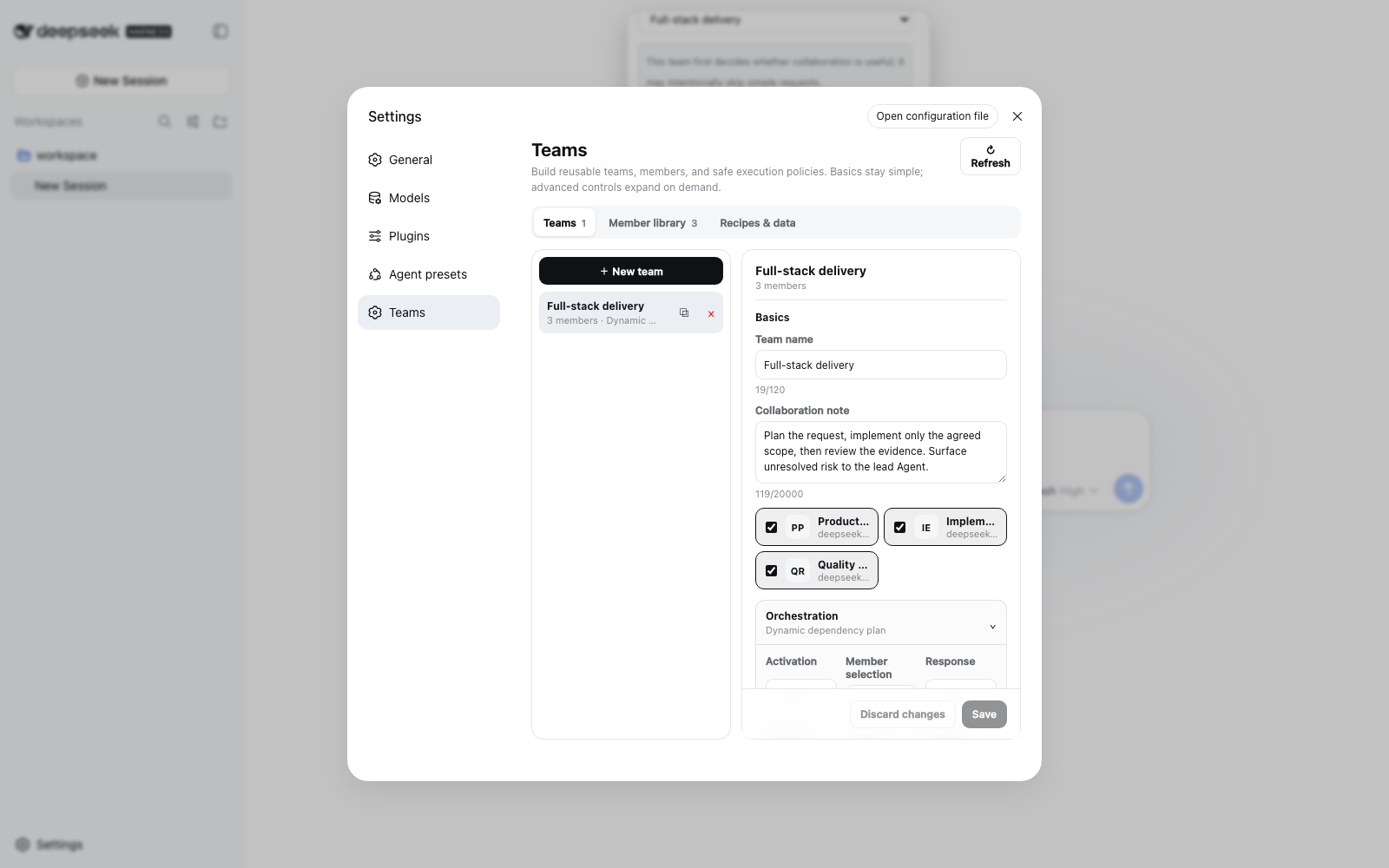
A team is a reusable product object, not a one-off dispatch form. Create it once in Settings → Teams, then use it across projects and conversations.
| Capability | User outcome |
|---|---|
| One model and tool policy per member | Combine a planner, implementer, reviewer, or specialist without forcing one route on everyone |
| Dynamic workflow planning by default | The active conversation's model assigns focused work and dependencies from the current request |
| Team / Solo / Inherited modes | Choose a durable conversation override, a project default, or a one-message exception without ambiguous switches |
| Bounded DAG, retries, quality gate, background work | Long work is observable, cancellable, finite, and restart-safe |
| Official provider Token usage | See input, cache-read, cache-write, and output Tokens with full/partial/unavailable coverage—never invented prices |
| Versions, recipes, and definition backup | Reproduce a team, share it without credentials, preview impact, and remap model routes before applying |
Install
Requirements: DeepSeek Harness >=0.1.0-rc.5 <0.2.0, the Web profile, Node.js
>=22.19.0 <23 or >=24.0.0 (Node.js 23 is not supported), pnpm, and at least one configured DSH
provider/model route.
dsh plugin --profile web add -w github:toolclub/dsh-agent-team-gui#v1.0.0
dsh --profile web
Git dependencies run this repository's prepare build. On pnpm 10 or later, the first command may
ask you to authorize that build. Add only this reviewed package to the Web profile file shown by
pnpm (normally ~/.dsh/profiles/web/pnpm-workspace.yaml), then repeat the same pinned command:
allowBuilds:
  dsh-agent-team-gui: true
Restart an already-running DSH Web process after installing or updating. Open Settings → Teams, create or import members and a team, then open the control beside the conversation composer.
[!TIP] If
dshis not onPATH, cloning Harness alone did not install a global command. From the Harness checkout usepnpm dsh --version, and replacedsh ...in this README withpnpm --dir /absolute/path/to/deepseek-harness dsh ....
Verify the composed bundle without installing rg:
dsh --profile web --dump-config | grep -E "agent-team-gui|dsh-agent-team-gui"
Expected output contains both the dsh-agent-team-gui bundle layer and the agent-team-gui row.
[!CAUTION]
allowBuildslets the selected Git dependency execute its build on your machine. Review and pin a tag or full commit SHA. A compiled release tarball does not need Gitpreparepermission.
First team in five steps
- In Settings → Members, create reusable members. Pick a configured provider/model, write a narrow role prompt, optionally add a fallback route, and grant only the tools that role needs.
- In Settings → Teams, create a team and select those members. Leave Fixed order off for dynamic planning, or enable it for a repeatable serial pipeline.
- Choose Always, Smart, or Manual activation; all members or an adaptive subset; foreground or background response; and optional resilience, budget, or review controls.
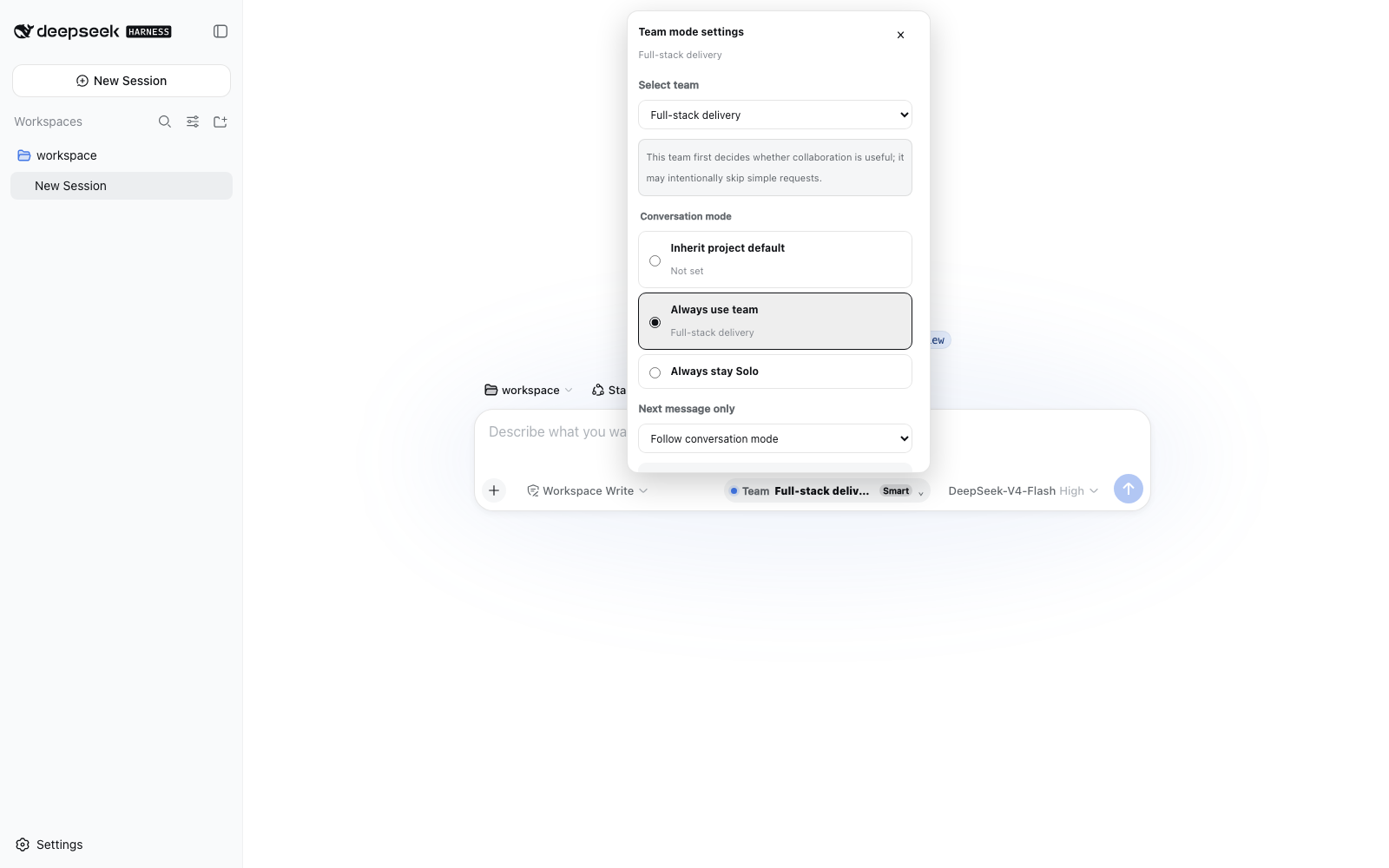
- Beside the normal composer choose Team, Solo, or Inherited. You can also queue a different team or Solo for only the next eligible message, or set a project default.
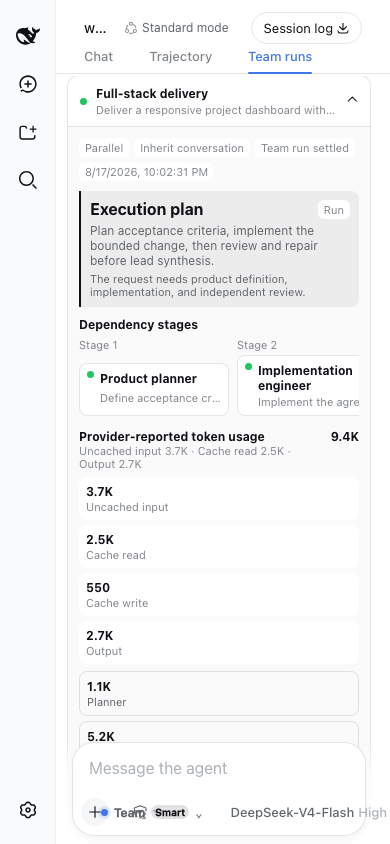
- Send the task normally. Open Team runs to inspect the plan, stages, members, review/repair rounds, outputs, errors, timings, retries, and official Token coverage.
How orchestration works
flowchart LR
    U["Normal user message"] --> M{"Conversation mode"}
    M -->|"Solo"| L["Lead Agent answers normally"]
    M -->|"Team / inherited default"| A{"Activation"}
    A -->|"Manual"| L
    A -->|"Smart may skip"| P["Bounded lead-model planner"]
    A -->|"Always"| P
    P --> D["Validated acyclic plan"]
    D --> W1["Ready member wave"]
    W1 --> W2["Dependent member wave"]
    W2 --> Q{"Optional quality gate"}
    Q -->|"Approved / disabled"| H["Bounded handoffs"]
    Q -->|"At most 2 repairs"| R["Named repair owner"]
    R --> Q
    H --> L
    D -. "live state + official Tokens" .-> C["Run Center and Insights"]
With no fixed order, the plugin uses the active conversation's provider/model route in a bounded, tool-free planner child. It receives the member roles and returns structured assignments plus an acyclic dependency graph. It does not turn one member into a replacement for the whole team. A bad, cyclic, or unavailable plan falls back to deterministic role-scoped assignments.
Ready DAG nodes run up to maxConcurrency. Dependants receive only bounded structured handoffs;
full member output remains in durable run history. A fixed member order is an explicit serial
override and bypasses DAG planning.
Activation and selection
- Always runs the selected team for every eligible top-level user message.
- Smart lets the bounded planner skip unsuitable/trivial work.
- Manual keeps ordinary sends Solo; queue the team for the next message or use the model tool.
- All members assigns each configured member exactly once.
- Adaptive lets Smart planning select the smallest useful non-empty subset.
Conversation modes
- Team is an explicit durable team selection for this conversation.
- Solo is an explicit durable opt-out, even when the project has a default team.
- Inherited removes the conversation override and follows the project default when one exists.
- Next message is a separate crash-safe one-shot Team or Solo choice, consumed exactly once.
These states remain interactive after page refresh, cold Host startup, and live reconnect. An empty or temporarily unavailable catalog never silently deletes a saved selection.
Safety bounds
- Planner, member, reviewer, and repair prompts put the exclusive role and no-delegation contract before a bounded excerpt of user content.
- Delegated sessions cannot dispatch another team. Detected DSH subagent tools—including renamed registrations—are denied inside team children.
- One durable claim binds automatic and model-tool dispatch to the latest human message, so repeated tool calls cannot create hundreds of duplicate teams.
- Member timeout, concurrency, retry-once, soft team Token budget, and quality rounds are finite.
- A retry creates a linked immutable run and replays the original normalized assignments, order, and DAG; it does not silently ask the model to invent a different workflow.
Run Center and Token usage
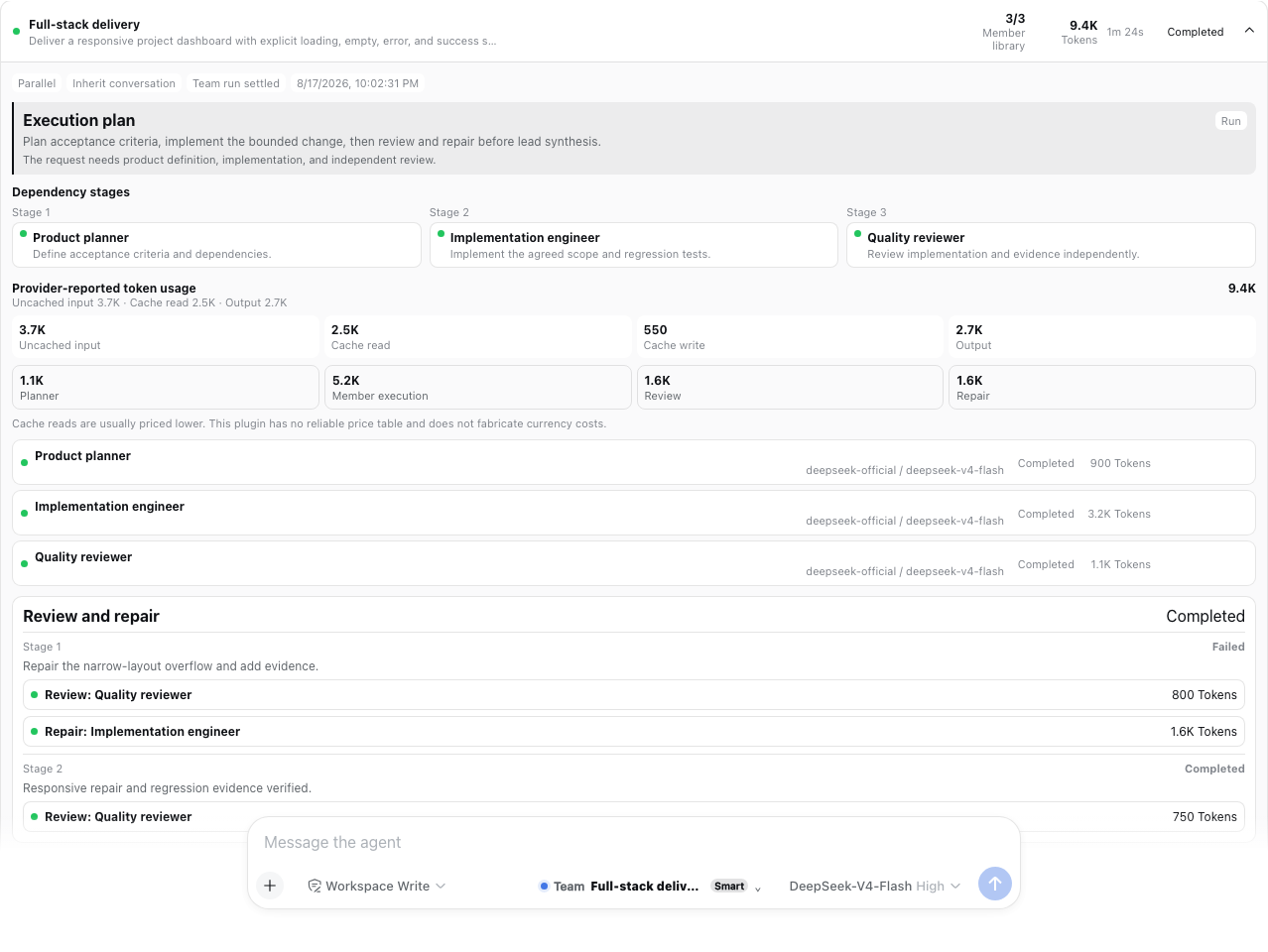
Every execution is written before planning starts. The Run Center exposes foreground/background state, live phase, elapsed time, child IDs, complete outputs, bounded handoffs, stop, linked whole or member retry, export, filters, and retention-safe clear.
The plugin reuses DSH's official tokenUsage projection and keeps four buckets:
- uncached input;
- cache read;
- cache write;
- output.
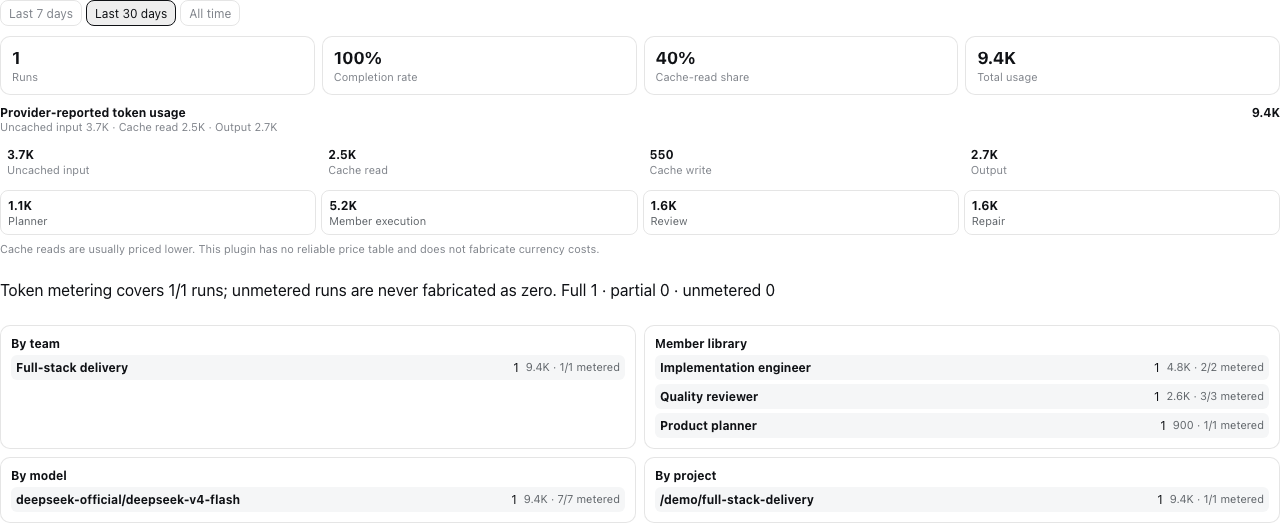
Planner, member, review, and repair usage remain separately attributable. Coverage is explicitly full, partial, or unavailable at run and retry-attempt level. Before a provider reports a sample, the UI says Metering… instead of showing a false zero. Tokens are not money; the plugin does not guess prices that Harness providers do not publish through a stable pricing contract.
Quality gate and background runs
An optional quality gate names one reviewer, one repair owner, explicit criteria, and 0..2 repair
rounds. A rejection can rerun only that repair owner, followed by the named reviewer. It cannot
create arbitrary agents or recurse.
Foreground runs finish before the lead Agent synthesizes bounded handoffs. Background runs return a short acknowledgement and stay visible in the plugin Run Center; when the official DSH Jobs service is present, the same run is also registered there with a shared cancel hook. Without that optional service, the plugin falls back to process-local background execution; a Host restart then reconciles unfinished durable state as Interrupted rather than pretending it completed.
Versions, recipes, and definition backup
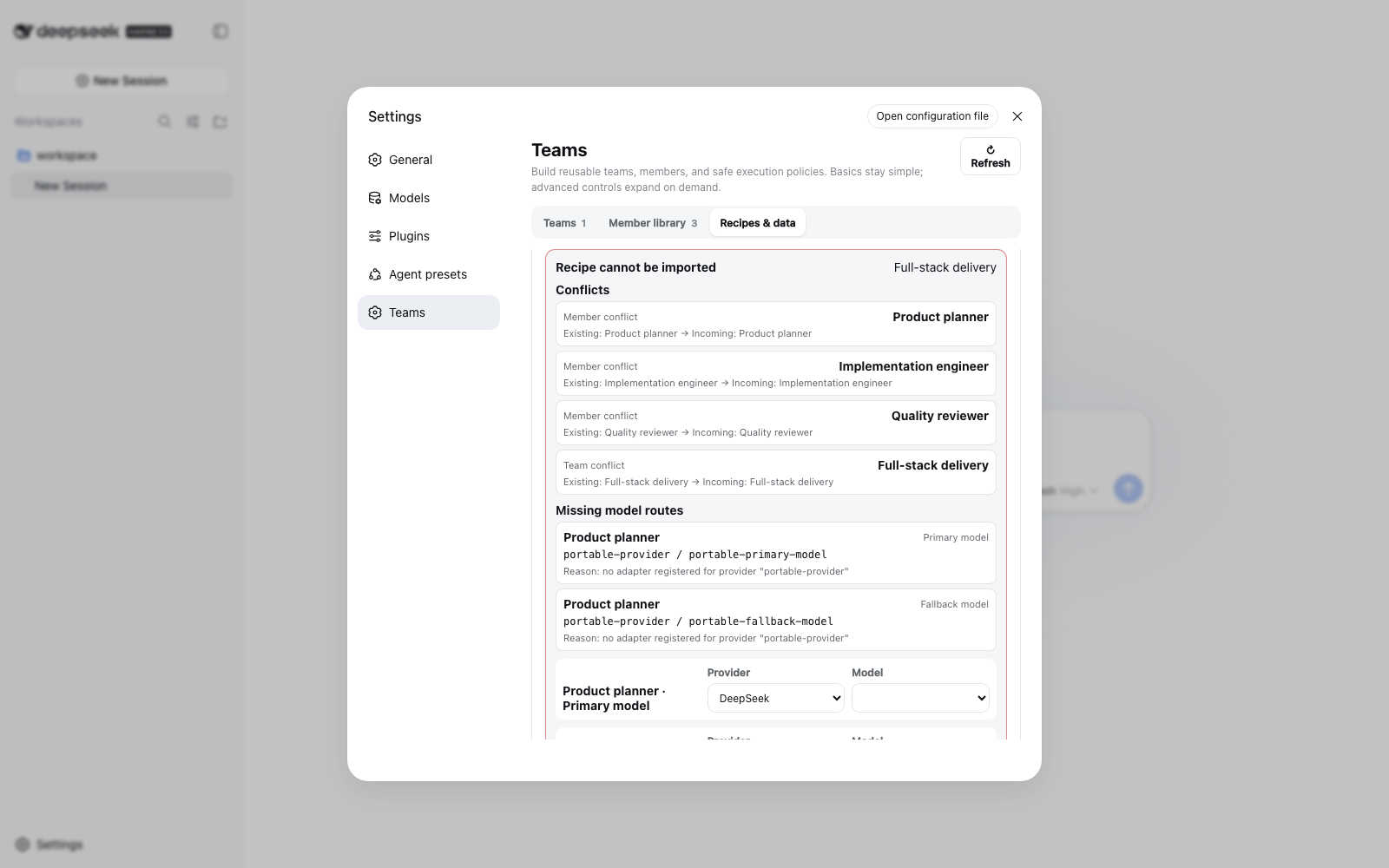
- Each saved team version includes immutable snapshots of all referenced member definitions.
- Restore is preview-first and warns when a shared member would change another team.
- Recipes contain one team and its members, never provider credentials. Import supports Copy or Merge, conflict preview, and separate primary/fallback route remapping.
- Definition backup exports agents and teams. Import is preview-first with Merge or Replace; replace reports deletions, dangling mode/default cleanup, and affected teams before confirmation.
- Multi-table writes are serialized and use compensating rollback on validation, cancellation, or storage failure. Readers see either the previous or committed definition graph, not a half-import.
- Remote recipe URLs are disabled in v0.5. Import a reviewed local JSON file; this intentionally avoids exposing an unprotected server-side fetch/SSRF surface.
Start with the credential-free
full-stack delivery recipe, preview it, and remap its
your-provider / your-model placeholders to routes configured in your own DSH profile.
Definition exports include member system prompts and model route names. Run exports additionally include the user task and member outputs. Review those files before sharing them.
Settings reference
Member
| Field | Meaning |
|---|---|
| Name and role prompt | Durable identity and exclusive instructions for this member |
| Primary provider/model | Existing DSH route; credentials stay in DSH |
| Fallback provider/model | Optional paired route for retry-once |
maxTokens | Hard per-attempt output ceiling sent to the provider |
| Tool allow/deny | Least-privilege visibility for registered DSH tools; recursive team/subagent tools remain denied |
Team
| Field | Meaning |
|---|---|
| Members and collaboration note | Reusable member definitions plus team-level coordination guidance |
| Fixed order | Complete serial permutation; leave off for dynamic assignments and DAG dependencies |
| Execution/context | Serial or bounded parallel; spawn, fork, or serial-only chain |
| Activation/selection | Always, Smart, or Manual; all members or adaptive subset |
| Response | Foreground synthesis or observable background run |
| Planner | Current/recent/full context and a bounded planner Token ceiling |
| Resilience | Continue, stop, or retry-once; member timeout and fallback route |
| Limits | Maximum concurrency and a soft provider-reported team Token budget |
| Quality | Named reviewer, repair owner, criteria, and at most two repair rounds |
Host configuration
The Web bundle inserts one unique Host row; it relies on the Web profile's existing storage, Connection RPC, models, sessions, and browser module services.
- id: agent-team-gui
  name: dsh-agent-team-gui
  config:
    defaultProvider: spawn
    defaultExecutionMode: serial
    defaultContextMode: spawn
    historyMaxRuns: 0
    historyMaxAgeDays: 0
    versionMaxPerSquad: 0
| Field | Default | Meaning |
|---|---|---|
defaultProvider | spawn | Registered DSH subagent provider |
defaultExecutionMode | serial | Effective mode when a team omits it |
defaultContextMode | spawn | Effective context when a team omits it |
historyMaxRuns | 0 | Count retention; 0 disables automatic run deletion |
historyMaxAgeDays | 0 | Age retention in days; 0 disables automatic run deletion |
versionMaxPerSquad | 0 | Version retention per team; 0 disables automatic version deletion |
If you override the row in a profile patch, restate every needed field: DSH patch rows replace the
complete config object rather than deep-merging it. chain is valid only for serial execution.
Retention is deliberately opt-in: upgrading to v0.5 does not silently delete existing run history
or team versions. Set a positive limit only when automatic cleanup is the behavior you want.
Other installation paths
Exact commit
Resolve and review a full commit SHA, then use the same allowBuilds rule as the tagged Git install:
dsh plugin --profile web add -w github:toolclub/dsh-agent-team-gui#<full-commit-sha>
This is the most reproducible source install. The release CI performs the same fresh-profile check against the exact pushed revision.
Local checkout
From this repository:
pnpm install --frozen-lockfile
pnpm run preflight
dsh plugin --profile web add -w .
preflight type-checks Host, Client, and tests; runs Host/rendered Client suites; builds from a clean
output directory; audits the tarball and secrets; and boots an isolated temporary DSH Web profile.
Compiled tarball
mkdir -p dist
pnpm pack --pack-destination dist
dsh plugin --profile web add -w ./dist/dsh-agent-team-gui-0.5.0.tgz
The package audit verifies runtime/declaration closure, examples, governance files, screenshots, source maps, external dependency declarations, no absolute paths, no symlinks, and no known credential patterns.
Ask a terminal-capable Agent
You can send this single instruction inside DeepSeek Harness:
Follow the installation and security notes in https://github.com/toolclub/dsh-agent-team-gui. Install the reviewed v1.0.0 tag into the Web profile, authorize only
dsh-agent-team-guiif pnpm asks forallowBuilds, restart Web, verify the composed configuration, and report the exact installed revision.
Model tool and public service
dispatch_to_squad remains available for explicit/manual model-driven use. It accepts a team ID or
unique case-insensitive name, a task, optional assignments/order, and execution/context overrides
where the saved team permits them. Its model-facing result is bounded; the complete canonical run is
durable and available through the Run Center/export.
The package also exports AgentTeamService, record/result types, Zod schemas, and the in-process
definition/dispatch/version/recipe/run APIs. Treat those APIs as developer-preview surfaces while
DSH itself is pre-stable.
Security and privacy
- The dedicated RPC channel is registered loopback-only and validates every payload/result. This is not an authentication layer for exposing DSH Web to the public Internet.
- Provider credentials are never copied into plugin records, recipes, examples, logs, or exports.
- Durable local storage does contain team role prompts, selected route names, conversation/project identifiers, user tasks, run outputs, errors, and Token usage. Protect the DSH home directory.
- Use least-privilege member tools. A model may perform any action that its allowed DSH tools permit.
- URL recipe fetching is disabled. Installation scripts are the only extra machine-code authority; review and pin Git dependencies or use a compiled tarball.
- Report vulnerabilities privately using SECURITY.md, not a public issue containing credentials or private prompts.
Compatibility and limitations
- Web profile only; there is no headless Settings UI. The exported Host service can still be used by another in-process plugin that supplies the required services.
- Declared compatibility is DSH
>=0.1.0-rc.5 <0.2.0; CI currently verifies rc.6. DSH and this plugin are both pre-stable, so pin versions. - Old v0.4 durable definitions and v1 exports remain readable/importable. Editing them must satisfy the safer v0.5 new-write limits. A legacy run without a stored plan cannot be faithfully retried and is rejected with an explanation.
- Provider Token projections are optional. Partial/unavailable coverage is expected and explicit.
- A soft team Token budget prevents later scheduling; it cannot stop an already-running provider at
the exact threshold. Per-member
maxTokensis the hard provider bound. - DSH currently offers no supported registration seam for custom durable
squad/*Session event types. The plugin uses its durable run store, standard child sessions/tool events, Jobs, and logs. - Model-tool trigger mode is best-effort because DSH exposes no
toolChoicecontrol. Guaranteed normal-send mode is Host-driven and durable-message-idempotent.
Verification and project health
pnpm run typecheck
pnpm run test
pnpm run build
pnpm run audit:pack
pnpm run smoke:install
pnpm run smoke:browser
CI runs Node 22.19 and Node 24, a fresh DSH rc.6 Web profile, browser keyboard/accessibility/reconnect journeys, exact Git revision installation, and the community plugin doctor. The detailed product contract and evidence matrix live in docs/v0.5-product-spec.md and docs/v0.5-acceptance.md.
Contributing
Read CONTRIBUTING.md, the Code of Conduct, and
SECURITY.md. The concise Chinese tutorial
从零开发一个 DeepSeek Harness 插件 explains
apply, Service plugins, profile/bundle wiring, local verification, and GitHub installation using
official Harness references.
Issues should include the exact DSH/plugin versions and a sanitized minimal reproduction. Pull requests should add focused regression evidence and keep compatibility, bounded execution, accessibility, privacy, and package closure in scope.
If this workflow helps, a GitHub Star makes it easier for other DSH users to discover. Real recipes, screenshots, and honest bug reports help even more.
Uninstall
dsh plugin --profile web remove dsh-agent-team-gui
Removing the package does not automatically delete durable plugin tables in the configured DSH storage backend.
License
Released under the MIT License.
Read the usage guide →
Install steps, key points, FAQ and compatibility for this plugin — auto-derived from indexed fields.
Listing badge

[](https://deepseek-plugin.org/plugins/toolclub/dsh-agent-team-gui)Paste this markdown into your GitHub README to link back to this listing. The badge only states the listing — not a security endorsement.